Monday, September 26, 2011

Farewell Flopsy

Farewell Flopsy.  Flopsy died last Monday.  Here’s a picture of Yaneth holding Flopsy earlier this year.  He has been my constant companion since he came to live with us.  Several years ago, while still living in Ciudad Colon, Animal Rescue friends asked if I would adopt some dogs that had been tortured by a very sick man.  He had already killed several dogs and, finally, the neighbors had had enough of hearing the pitiful yelps of dogs getting beaten.  Flopsy came to us with broken ribs, a broken jaw, missing teeth and lesions all over him.  He could barely breathe without whimpering in pain.  I swore the day he came to us that he would never suffer again, if I could help it.  It took a long time for his injuries to heal, and years longer before he would even let us pick him up without yelping in terror.  But time heals all wounds, and we were so glad when he trusted us enough to finally let us pick him up and hold him. 
And, thus, he lived at the farm and went with me everywhere.   We took the most recent pictures of Flopsy, while hiking with Armando and the other dogs down to the waterfalls this past August.  He kept up just fine with all the other dogs, despite having lots of white whiskers – showing his age.  But he remained healthy and active until just a few weeks ago, when I noticed that he was losing steam, couldn’t keep on weight, and began showing signs of kidney failure – an ailment that had already taken his companions, Chispa and Spotty.  Thus, we sadly recognized the same symptoms.  I suspect the cause of the kidney failure but am not sure – we have taken preventive measures. 
The last week, we knew that, soon, Flopsy was going to die and that there was nothing we could do but support him and keep him comfortable – and let him rest peacefully at home.  We have learned that if we take a dog with kidney failure to the vet, the dog does not come back home alive.  In no way do I want to denigrate our very fine and compassionate small animal vet, Dr. Rojas, in Ciudad Colon.  But he would be the first to agree that, sometimes, it’s best to keep the patient comfortable at home and not subject a dying animal to more stress, like IV drips and caged confinement, closed up with other sick animals.  Flopsy had a very good life after his rescue.  He brought smiles to us all with his very conversational…waoo wuoo wao wuoo and was much loved.   Farewell Flopsy.


Thursday, September 22, 2011

m’a sa-laam-a Dr. Mahmoud El Zain Hamid

We were shocked and saddened to learn that Dr. Mahmoud El Zain Hamid died on Monday, September 19, 2011, while teaching at the University for Peace.  Mahmoud lived to teach – and inspired so many people in so many ways, that the University for Peace plans a special Memorial for him, so that people can give voice to how he touched their lives.

Yesterday, the University for Peace held a very nice remembrance service for Dr. Hamid, prior to celebrating planned activities for the International Day of Peace.  One of the students chanted a passage from the Koran, which was deeply felt by everyone.  Many tears flowed for this very kind and good man who left this planet far too early. 
We want to say to the world what Gerry said to Mahmoud when we last saw him:  “Thank you”!  Mahmoud inspired Gerry to go out and buy the publication:  ‘Climate Change 2007 - The Physical Science Basis’; the Working Group I Contribution to the Fourth Assessment Report of the Intergovernmental Panel on Climate Change.  This massive document includes all the data and evidence pointing to the fact that the planet has, indeed, entered another period of global warming.  Gerry carefully read the book, studied all the data and analyses, and is now now more convinced of it (although not at the pace, nor with the certain catastrophic outcomes that some non-objective politicians and activists with their own personal agendas will have us believe).  The world must, therefore, brace for future change and mankind must adapt.  Mahmoud understood this; he came from Sudan to bring his message to the world at the University for Peace.  He passionately cared about the impact of climatic change on the peoples of the world.  He will be deeply missed.

After the remembrance service for Dr. Hamid, the students formed a large ‘circle of gratitude’ as part of the International Peace Day.  People from all over the world joined hands and, for many moments, we shared a collective sense of warmth and goodwill.  For me, it was a very deep and satisfying feeling to share with so many people.  I remain optimistic for the human species.           

Monday, September 19, 2011

Box Fight in Pricemart

So what’s life been like since Gerry retired?  Well, I’ll give you the latest little episode.  I usually enter the Membership Warehouse Store, Pricemart, with a list and a mission:  to get in and out of there as fast as possible.  When Gerry retired, I eventually talked him into going with me to help haul out the big, wholesale-sized packages, even though he really dislikes shopping in general and these ‘Big-Box’ places in particular (“I abhor these appalling bloody abysses, with their retarded zombie staff”).  He tries to avoid it like the plague – but, over the years, Gerry has learned that it’s sometimes best to take the path of least resistance…  Still, from day one, he made it clear that he only entered that store under great duress.  And that I owed him.  This trip last Friday was no exception but his mood was even more foul than usual - and I was irritable too.  So we walked in there with the list, quickly piled up the supplies in the shopping cart and went to the check-out counter.  While Gerry was unloading the items onto the conveyor belt and the clerk was scanning the items, I quickly moved to the end of the counter and packed them neatly back into another cart.  Every action was designed to expedite the process, in order to get out of the store as quickly as possible and with the minimum of fuss.

So, I had just finished stacking the items and was ready to sign the credit card receipt, when Gerry storms through the crowd, takes one look at our neatly stacked shopping cart, and does not like what he sees!  Suddenly, he demands of a ‘packer’ more boxes to pack up the merchandise the way he wants to do it!  He needs lots of boxes – and he wants them “ya” (right now, for non-Spanish speakers)!  So now boxes are flying, clerks are running to get more boxes - and I am burning with fury; I just want to…

…grab a box and whack Gerry up-side the head with it!  So he grabs a box and throws it at me – and now boxes are really flying.  And now everybody is throwing boxes…  Boxes are flying everywhere…  It’s a Box Fight at Pricemart!  And now everybody is laughing – because it is all so ridiculous – and everybody now gets a couple of boxes to take home. 

Wait a minute!  Did that really happen?  Well, some of it did.  As Gerry demanded boxes and more boxes, I ended up just paying for the bill, my face blazing hot with rage and embarrassment.  But I remained silent, keeping in mind that the mission was to just get out of there; Gerry gave the harassed ‘packer’ a good tip and we left the store – and we didn’t really start to laugh about it until later.  Did that really happen?  Did we just behave that way?  The main thing to remember in situations like that is to keep laughing and loving, no matter how much you want to pick up that box and…

Wednesday, September 14, 2011

What is this Caterpillar? Answer: Frangipani Hawk Moth Larva

Can anyone identify this caterpillar?  Thank you Kathryn Kostka de Tanzi and Barry Biesanz and Mark Plotkin for the feedback!  This is a Frangipani Hawk Moth Larva called Pseudo sphinx tetrio - a sphinx moth- that loves Plumeria trees - and also Oleander trees.  We had about 15 of these colorful creatures living on the Plumeria rubra (Frangipani) trees during most of August.  They chomped down on the leaves and soon nearly doubled in size, each caterpillar claiming his own branch, and eventually they ate all the leaves.   I need not have worried, the leaves quickly started growing back and no lasting damage was apparent.  What would they morph into next?  One day I decided to take these pictures.  And it’s a good thing I did, because the very next day all the caterpillars were gone.  Sometime during the night, they all came down from the Frangipani trees and went somewhere else! 
Every year around this time, we see these caterpillars - Tetrio Sphinx-  during this particular phase of their life-cycle.  They are so colorful as larva but morph into a rather dull, grey moth.  Robin came over and saw one thrashing about - why?  It was trying to avoid a pair of bees trying to sting it!  Not sure if Robin got the shot. 


Actually, right now is high season for butterflies in the El Rodeo forest; there is an astounding variety of them, which would dazzle any collector, or even any non-collector for that matter.  And there is much to learn from them.  Our neighbor has even observed moths that mimic wasps.  Nature never fails to astonish and fascinate, offering lessons to those who want to observe and study it, and producing a state of wonder for those who just want to walk within it.
So what’s this big white bird running about with our hens?  We now have a turkey out at the stable!  Until recently it belonged to a neighbor, who bought a pair of them with the idea to breed them.  But her dog had a different idea…  That big bird was just too tempting.  So, after the female became Thanksgiving doggie-dinner, she asked us to adopt the male, and he has adapted surprisingly well.  He seems to get on with the hens – he doesn’t bully them and they don’t peck him. 

He’s a gentle giant in a hen house where, yes indeed, there is a pecking order…  We let them out into their garden during the day but they all go back inside at night, along with the turkey.  We have learned that the forest can very easily make quick meals out of ‘free-range’ hens.  But Jose has accomplished the next to impossible – he has created conditions so that the hens can thrive in a ‘free-range’environment yet survive. We breed criollo hens for their eggs. Criollos, like all natives, can resist illnesses and are adapted to the tropical climate – and they produce incredibly delicious eggs with very bright yellow yolks!

Wednesday, August 31, 2011

Seeking Wild Tomatoes

I am a tomato freak.  One time at a dinner party, a friend told me, “Do you realize that the only thing we’ve talked about all night is tomatoes?”  Those are the sorts of friends I have.  Back when we lived in PA and NJ, I tried growing lots of tomato varieties, and so relished the taste of a tomato just off the vine after flourishing in the long summer sunshine.  The best-tasting tomato is the one you grow yourself in your garden.  The reason why store-bought tomatoes taste so insipid – the more perfect the red tomato you choose, the more insipid it is likely to taste – is due to commercial practices. 

Read investigative food journalist Barry Estabrook’s book, called ‘Tomatoland’, for the sad, shocking story of tomato cultivation.  Estabrook inspired me to look again at the original wild tomato, the tiny cherry tomato – Solanum pimpinellifolium – progenitor of the modern tomato.   Unfortunately, since tomatoes have been cultivated commercially, the original wild tomatoes have become rare, even to their native Andes.   Estabrook described his expedition in the Andes in search of the elusive wild tomato.  He obtained GPS coordinates of a, “pretty good cluster”, of wild tomatoes from the well-known tomato geneticist, Roger Chetelat, of the University of California at Davis.  Chetelat e-mailed him a list of common names to help him in the search – tomatito, tomate de campo, tomate de culebras, tomate de zorro, tomate silvestre.  The names tell us that the locals refer to the progenitor as a ‘wild tomato’, not really a tomato that they would cultivate and eat. 
His Peruvian expedition was full of unexpected adventure but, finally, Estabrook found the plant way up in the high desert of Peru.  Solanum pimpinellifolium was a scruffy plant; scruffy but surviving, despite impossible odds – and laden with tiny tomatoes!  He popped a tiny tomato into his mouth and described what he tasted:  “The bright, sweet pop of taste was followed by a lingering, pleasant tartness, that essential balance that defines a great tomato.”

Unfortunately, the store-bought tomatoes are just as insipid in Costa Rica as everywhere else, but it’s not easy to grow large tomatoes in the tropical garden.  The sun sets in Costa Rica by 6 p.m. year round, and the rainy season limits sun to less than 4-6 hours daily, which significantly reduces the variety of tomatoes that you can grow here.  Thus, small is better.  Tiny tomatoes have a chance to ripen and turn nicely red on the vine long before the tropical elements begin to attack, which invariably happens with large tomatoes.  Where could I find a Tomate Silvestre here in Costa Rica? 
Our search led us to our friend, Hugo A. Zuniga Molina, who has carved out a totally self-sufficient garden paradise for himself and his family up near Pico Blanco in Escazu.  Years ago, he found some tiny tomato plants while walking in the wild areas of high Escazu, took them home and planted them.  Now, they are all over his garden, clearly healthy and seeding readily and delicious.  However, Hugo did remind us that for reliable results, we should ferment the tomato seeds (from the basket of tomatoes that he generously allowed us to pick!), not dry them, prior to germinating them in our garden.  We’d found our wild tomato! 

Hugo regards nature as his teacher and, over the past 25 years, has transformed a steep mountainside into a series of terraced gardens, just like in Peru, where the (now) rich, composted soil produces an amazing array of edible plants.  He collects all the water from the rooftops and directs it into holding tanks, where it is recycled back throughout the garden and into fish ponds.  His septic system produces gas for his kitchen and treated water further down the mountain, which flows crystal-clear into a stream.  Hugo doesn’t recognize any plants as ‘weeds’; all plants have organic value at least.  And most have much more value to man than that; it just requires a little observation and study to discover it.  He explained that every problem on the tropical, organic farm can have very simple solutions, if you just stop to think about it – how to conserve seeds, recycle hydroponic water, produce fertilizer, and so much more, to make your farm more productive and ecologically sound. 

You can learn more about Permacultura Pico Blanco by contacting Hugo and Norma at email:  picoblaco@ice.co.cr
Or take a look at their website: http://Sites.google.com/site/montniveus
It’s clear to all that I’ve been thinking a lot about gardens and weeds lately.  Yes, I just finished Richard Mabey’s delightful book called ‘Weeds’, and it just brought back the whole English realm of gardens, gardening and gardeners.  We used to go to England regularly for Pubs & Gardens tours – Gerry picked the pubs and I chose the gardens.  I loved them all but grew increasingly more fond of the natural, woodland ‘gardens’, such as in the Lake District - natural, free-flowing plantings.  As time went on, and after visiting possibly hundreds of gardens worldwide (but mostly in England – oh! the English and their gardens), I felt certain that you just cannot improve on nature.  The most breathtaking places on earth are natural woodlands.  Humans can create stunning gardens – but we can’t improve on natural succession. 
Reserva El Tigre is mostly forest – left to nature – with the gardens confined to near the house and the solar panels.  Over the last several years, the garden has evolved, as I evolved as a gardener, from exclusively exotic ornamentals to a mix of edibles and mostly native ornamentals.  Volunteers popping into the garden – called weeds by those who maintain designed gardens - are mostly welcomed to our free-form, somewhat chaotic world of green.  It turns out that some of the ‘ho-hum’-looking plants that unexpectedly appear in the garden can have great value.  In fact, a large clump of a rather weedy-looking shrub, Witheringia solanacea (yes, the tomato family again!) has brought students here from the University of Costa Rica, avidly collecting it for their research – yet another effort to seek the true value of weeds!
      

Sunday, August 28, 2011

Mr. B's Story

So here’s how it all went down, at least as Mr. B later recounted his story to us - hysterical and true!  Gerry has heard Mr. B repeat this story a few times and laughs just as heartily as the first time he heard it!  And now the word is out!  Here’s how it was that night in Escazu:

There had been a robbery in the neighborhood the day before, so Mr. B. brought his guard dog home from his business establishment for a few nights to protect his house.  As he told Mrs. B, the dog will bark and chase off anybody who tries to jump the fence into the garden.  And the next door neighbor also reassured Mrs. B that, if any intruder gets past the dog, then he would get out his gun and scare the thieves off!

So that soothes Mrs. B’s nerves and so, after dinner, she goes to bed.

Meanwhile, Mr. B goes outside on the front porch for a smoke and a nightcap, watching his dog loll about in the garden.  The bar at the end of his cul-de-sac was bellowing out the usual music for the usual crowd (a highly questionable bunch – at best…).  But Mr. B is used to the racket; it’s just the normal background noise on his street.

Suddenly, Mr. B watches somebody’s hand slip through the fencing but realizes that it’s an employee from his shop, who knows the dog well, walking by outside.  So, the boy pokes his hand through the fencing for the dog to sniff and whispers some sort of doggy endearment to it.

However, Mrs. B couldn’t sleep, hears something, looks out of the window, sees a hand coming through the fence, and starts shouting – very loudly...  The dog then starts barking (the employee having rapidly disappeared, of course); the neighbor gets his gun and begins shooting into the air!  Well, now all the people at the bar run out, accompanied by much shouting and furor, scrambling over each other to get away (not knowing who was the target of the armed attack, but almost all with good reason to think it was them…) tearing down the street past Mr. B’s house.  And then, just to add further confusion, a police car that was driving around a couple of streets away, hears the shooting and comes screaming in to investigate, producing the usual, age-old response :  nobody knows anything; nobody was there; and, if they were there, nobody has a gun…  And so, finally, everybody goes back to bed.

However, as Mr. B recounted to us with a big smile on his face, he is still the only one who knows what really happened that night…

Monday, August 22, 2011

For Sale: Little Gerry

 Little Gerry (the calf) was born on Big Gerry’s (the husband’s) birthday last March.  Big Gerry had originally destined Little Gerry for the freezer and thus, for the past 18 months, the calf has been living an idyllic, pastoral life until the day would come when… “You won’t even know what’s happening, Little Gerry”….thwack.  However, this is Costa Rica, and so the long saga began.  Thank you everyone for all the logistics help related to a 4H-approach to knowing where your food comes from:  certifications, timbres, refrigerated transport to hygienic facility, professional butcher, vacuum sealing and, voila – ready for the freezer. 

But, “What were we thinking???”   

We don’t even have a freezer with the capacity for Little Gerry!  We are 100% Solar Power.  And what really made us question our sanity was this:  we rarely eat red meat anyway – no matter how excellent the quality!

Why not keep Little Gerry as a pet?  I learned that lesson the hard way.  Bovines are not equines!  They are a lot more trouble!  The short answer is to read the book:  “A Naturalist on a Tropical Farm”, by Alexander Skutch.  I read his warning on keeping bovines – the flies, the torsalos, the broken fencing.  Cows are vagabonds – but did I heed his warning?  Of course not; ‘stupid me’ had to learn my own lesson the hard way.  Of course, nowadays we have modern methods for controlling pests, as well as traditional ones – like stable hens chomping down on larvae and insects – but it’s a continuous battle to keep pests under control in the tropical forest.  And we always have to think about resistance.      

So what was I thinking?  Well, things always have a way of cascading.  We just planned on keeping one cow, Lola La Vaca, for her milk, and we just vaguely, kind-of, destined her future calves for the freezer.  We didn’t really think much about the how and the why until we got started with the logistics.  And that’s when the saga began.  Little Gerry was Lola La Vaca’s second calf and, at the time, I was really keen on making our own cheese and yoghurt.  So we were just beginning to experiment with her natural bacteria for cheese-making when she died.  Much to our shock, she died from an infection, a week after the traumatic, caesarean delivery of her third calf, stillborn, on Easter Sunday. 

And that put an end to bovine cheese-making!  I thought briefly about goats – goat yoghurt is wonderful – but right now I’m taking a break from animal husbandry - and home-made, milk-based products!  Now I’m taking the path of least resistance and staying with organic gardening and just doing battle in the plant world.  Biodiversity is the key to organic gardening in the tropics:  mix many plants together; include lots of pest-attracting natives, like Tuete; and go with the flow.  Stick with plants that thrive and don’t slave over plants not suited for the location or that require too many resources to keep alive.

Some weeks ago, back when I was feeling a bit glum about having to give up on yoghurt pro-biotics, fellow gardener, Hugo Zuniga, introduced me to plant pro-biotics:  Water Kefir, gelatinous masses of beneficial bacteria and yeasts (also called Japanese Water Crystals, Ginger Beer Plant, Snow Lotus, Tibicos and other names).  I had lots of fun playing with recipes – trying to make it more palatable, so that somebody besides just me would drink it, but nobody really liked it - except the ants, which just love tapa dulce and completely invaded the kitchen!  So now Yaneth is grumpy and the Water Kefir is in our little freezer.

We haven’t completely eliminated animals, however!  The horses have adapted very well to forest-living and, now that the guys have built a proper enclosure for our chickens, they have begun to breed and thrive.  It’s fascinating to watch chickens – the protective mother, the pecking order.  But then, I’ve been observing insects lately – even having conversations with them, “Stay off my basil”!

Insects are the big problem here in the tropical garden, not so much ‘weeds’.  I’m currently reading this book about Weeds, by Richard Mabey.  He describes the correlation of weed behavior with human behavior:   humans, by reducing biodiversity, enclosing the Commons, introducing mono-culture, and applying chemicals, allowed only the toughest plants to survive, irritate, vex and plague humankind; who are now determined to eradicate the pest that they helped to create!  Mabey is a fun-to-read, botanical author like Michael Pollan; fun reading but with many insights.  The weeds we have in the tropics are mostly exotics that escaped from gardens, although the Pro-Nativa organization has recently been quite effective in guiding Costa Rican gardeners to plant native plants, rather than foreign ones.

So, the upshot is, we have no freezer for Little Gerry.  Do you want to buy Little Gerry for your freezer?  He is a natural grass-fed animal, who is in very good condition, unlike most cattle in this country.  Big Gerry is very unhappy about this but has agreed that it makes most sense to sell him – even though he threatened to put me in the freezer for prematurely whetting his appetite…

Monday, June 20, 2011

Monkey feasting on Pitahaya fruit

The monkeys always get the very best!  Here’s a shot just outside the bathroom window of a Capuchin monkey snagging the last and best of the Pitahaya fruits.  We’d have grabbed it first but couldn’t persuade anybody to climb up the tree to get it… 


Here’s a shot of the same Pitahaya cactus in full-bloom a few weeks later; the flower is huge, white and night-blooming.  I took this picture at about 5 a.m. while the flowers were still wide-open.  I also found another bloom on a cactus growing closer to the ground, with a slew of stingless bees pollinating it.  However, by 9a.m. it had closed, and that was that.  Show over. 


Willow Zuchowski, author of ‘A Guide to Tropical Plants of Costa Rica’, writes of Pitahaya: “The epiphytic cactus with the most impressive flowers is a dry-forest, night-blooming cereus, called pitahaya (Hylocereus costaricensis), a species with branching triangular stems.  In the wet season, the fragrant flowers open to a diameter of ca. 30 cm.  The bright magenta fruits are edible, and pitahaya-flavored ice cream is sometimes sold at the Pops ice-cream chain in Costa Rica.”


Yes, it’s true!  Fea still lives!  We estimate that she is at least 23 years old.  Back in Pennsylvania, our groundsman found Fea abandoned on the country road leading up to our farmhouse.  She was nearly dead from exposure, her Persian fur matted into a filthy mess.  He took her to the local vet, The Cat Doctor in Hellertown, who fixed her up - thank you, Susan - and a few days later, I spotted this scrawny, naked, really, really UGLY cat wandering around the barnyard.  He told me the story and hinted that he really didn’t want the ugly cat, so I took her and named her Fea – Spanish for ‘ugly’...  But then her fur grew back quickly, she thrived, and she even traveled with us to Costa Rica, where she has lived with us for the past 14 years.  Fea nearly died several times here in Costa Rica - this is a cat on her 8th life!  I remember thinking more than once that Fea would be dead by the following morning – after the scorpion…snake…bad fall…bufo toad…and assorted other unknown ailments - but Fea was always with us the next morning and back outside again, where she thoroughly enjoys tottering about like a drunken sailor...

Sunday, May 29, 2011

Menguante de Mayo

It was a full-moon for our last night in New Orleans, and the Mississippi river had nearly crested the levee nearby where we live. To save New Orleans from another devastating flood, the Corps of Engineers had just opened the Morganza Spillway upriver, flooding thousands of acres and causing much heartbreak. We left the next day for Costa Rica – coming home to a waning moon.

And there is no more important waning moon in Costa Rica than the ‘Menguante de Mayo’ – when we all rush to plant and prune as the first rains of the season begin.


And, Oh, the joy of farm-living; we came home to the Finca, finding abundant fruit – citrus, mangos, granadillas, pitanga, papayas, bananas, manzana de agua, capulin berries, and still more coming – all of it just so delicious! The air is fragrant with orange blossoms!


And what a bumper crop of mangos we’re harvesting this year - the best ever since Armando pruned and fussed with the trees. You have to pick mangos at just the right time, before the fruit gets too soft, box them up with newspaper, and then - get out them recipes! So far, we’ve made mango chutney, mango ice-cream and mango cakes; we’re sharing mangos with everybody in the neighborhood - even though everybody has their own mangos this time of year; and we’re even thinking of freezing some for the off-season… And, if that’s not enough, the unripe, sour criollo mangos are also ready – perfect for a tropical mango salad!


It has definitely started raining here – although quite late in the month for us - so we are very busy planting and pruning. After several years of living in the forest, I have come to cherish the small spaces of sunlight, not just for powering our solar panels but also for the gardens. Basically, we have allowed native, forest species to take over the ornamental gardens, and all the other sunny spots have been snagged for the edibles. Where there is sun and a source of water, we will grow edibles. In general, it makes more economic sense to go to the local organic markets to purchase your food. But there is no greater pleasure - and no better tasting food - than to grow your own! The big secret, besides finding the right sunny, well drained spot, is the soil. We’ve learned a lot about composting in the Tropics. It goes without saying that the horses, cows and chickens have done much to enrich the soil… And now, as we enter the rainy season with fewer sunny hours, we hasten to harvest the tomatoes before they succumb to too much rain and not enough sun. We have recently planted smaller varieties hoping that they ripen faster. Experiment, experiment, experiment…

The start of the rainy season also means fewer sun-hours for our solar panels. We have discovered that the key to solar-living is attentive maintenance and flexibility in the consumption of power. Also, we have all had to learn a smattering of electrical engineering just to live with the system. It took a few bumpy years of too many hours of needed generator back-up, before understanding how to live comfortably and efficiently with solar power. For example, when the generator came on in the middle of the sunny dry season, Armando learned that we have to wash the panels regularly to keep off the dust, because it significantly lowers efficiency. But now the daily rain will help with that task, although there is obviously less sun during the day! There’s always some issue to think about, and then deal with, when you’re living ‘off the grid’…


Geovanna and Lucero
The horses are doing very well indeed at the moment. We watched them today, feasting on grasses growing in the pastureland below the house. However, the biting-fly season is starting early this year! Luckily though, we have found that more flies pester us on the opposite side of the mountain, when we go out riding near the rivers; so far, there are not that many flies up in the pastures on our side – yet! We have been trying for years to reduce the pesky insect populations – cleaning drains, composting manure, treating the animals - and we had great success last year. This season could be difficult, however, because we don’t usually see many biting-flies anywhere until around July - and it’s only May! It goes without saying that we’re experimenting with herbal repellents – they all work but are too short-acting – especially citronella, which works best in mixtures with other herbs. You have to vary the formula frequently to keep confusing the bugs, and not allow them to get used to the scent. They should ideally be fragrant and pleasant to us, but really nasty to the mosquitoes and flies…

I was delighted to read in La Nacion and see on local TV newscasts, that they are re-planting the city park in San Jose, La Sabana, with native species, some of which are coming from the CNFL nursery located at the University for Peace – just up the road from where we live. The forest here in El Rodeo is actually spreading to La Sabana! We are thrilled for the residents of San Jose because these native trees produce berries and flowers that attract many species of birds and other fauna. The Sabana park will become much more like a forest, bringing joy and fascination to all those who appreciate Costa Rican biodiversity. There is no greater comfort to the spirit and body than a walk in a beautiful park. Just the beauty of the nature all around you brings such pleasure, and soon you feel your troubles lifting. Everything becomes possible, do-able. Of course, I’ve sought out parks all my life. No matter what city I have found myself in, and no matter how much stress I have in work or life, I have found solace in the city park. Back in Michigan, parks were everywhere – practically every neighborhood has a park – some with lakes. Now, San Jose will have a park worth visiting, and I am just delighted.

Can you imagine reading such a question on an official, national Census Form: “How do you primarily dispose of your garbage?” And one of the possible answers to check is, “Dump it in a river, a stream or the sea”! Believe it or not, that was a common disposal method in Costa Rica until recently, and now the new Costa Rican Census will quantify, among many other things, how Costa Ricans currently dispose of their garbage. That shows how important the subject has become in this country, when the government wants to try to quantify the problem. And, not only that, Question 17 asks specifically about re-cycling. Why do I write so much about re-cycling? Because we live ‘off the grid’ and have no municipal services at all – including no garbage pick-up. So we have learned to re-use and re-cycle the vast majority of everything we buy. Necessity is the mother of invention!

Since returning to Costa Rica from NOLA, we’ve read several news reports about re-cycling and clean-up efforts. Volunteers began cleaning up rivers last spring, including here in El Rodeo, and the movement has apparently now spread all over the country. What has really impressed me about the Costa Ricans is that they are now not only embracing the concepts of re-using and re-cycling, but also that they want to go out and help make things right. Business opportunities have also consequently grown, as people become aware of the value of re-cycled materials. Here in El Rodeo, the re-cycling company, Servicios Ecologicos, picks up re-cycled materials from households on a regular schedule, now that we have had to remove the community re-cycling bins because too many uninformed people were just dumping unsorted trash, not using the correct bin, or making a mess in general. Every change in this world requires a process of education and lots of patience… The main thing is that we are headed in the right direction. I see much less trash littering the woodland roads now than a few years ago, although we always carry along a bag to pick up crap when we see it. All any of us can do is set an example.

The kids joined Armando and me for a walk this past weekend. Oh, how the kids have grown! We wandered the trails and took a few pictures. Here’s a shot of the group.

Sunday, May 22, 2011

Tropical Biodiversity in Costa Rica

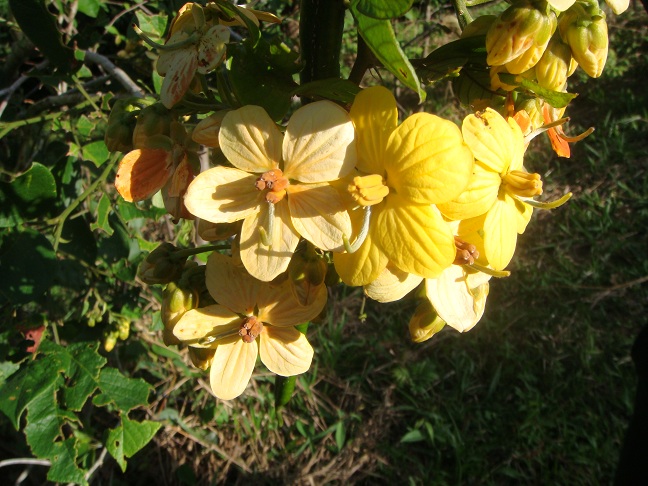
Senna papillosa, F. Fabaceae

Have you ever wanted to know the name of that beautiful, fragrant tree flowering just outside your window? Would you like to learn a simple method for identifying trees in the maddeningly complex plant world of the Tropics?
Then I can enthusiastically recommend a two-week, intensive field course on Tropical Biodiversity in Costa Rica given by Dr. Humberto Jimenez Saa. You will travel to breathtaking forests throughout the country and study with renowned local experts, for example Luis Poveda, Willow Zuchowski in Monteverde, Francisco Morales and others from the Tropical Science Centre, INBIO, etc. As you explore these diverse habitats, you will be introduced to ‘the Matrix’ – a sort of mind-mapping, botanically-based system of plant recognition. I took the course with Kathryn Kostka de Tanzi – we became like sisters after rooming together for two weeks – and very soon we were speaking botanical Latin with confidence... Check out Kathryn's pictures of our course at the Tropical Biodiversity website:  http://www.hjimenez.org/

To this day, I still frequently refer to the Matrix for identifying unknown plants that I come across while hiking. It is an easy-to-learn, but exceptionally effective method that you will use throughout your life to amaze your friends!

Dr. Jimenez has a Course coming up in English in June. Take a look: http://www.hjimenez.org/

Tuesday, May 03, 2011

Monday Morning after Jazz Fest

Lola la Vaca
It was early Monday morning after Jazz Fest, when Armando phoned and told us that they had found Lola la Vaca dead from post-op complications, probably an infection. Her still-born calf was buried last Easter Sunday. One week later, on May 2nd, they buried Lola. Everybody thought that she was on the mend, recovering from the major surgery; Armando was giving her antibiotic shots everyday and she was beginning to eat again.

Finding her suddenly dead on Monday morning shocked and saddened everybody. Lola was a sweet Jersey-mix cow and, thanks to her, we learned how to make yoghurt and cheese, even starting to work with her natural bacteria. This third calf was highly anticipated – soon Lola would share a little of her milk with us again! Now we have to rethink everything.

Little Gerry
Lola is survived by her two calves, Negrito and Little Gerry. Little Gerry was born on Gerry’s birthday last March. He will continue living an idyllic pastoral life until November, when he won’t even know what stunned him; and then to the freezer (Little Gerry that is, not Gerry…). So, by the end of the year, we will no longer have cows living at Finca El Tigre. My experiment with dairy cows is coming to a close.

Fortunately, the other animals are all okay. The chickens are doing well, after many struggles keeping them safe from forest predators (as well as that big, untrained puppy, Zincy). The horses have adapted to forest living and are doing very well indeed.

And now, the rain has begun again in Costa Rica, which signals the busiest time of the year for planting. We are putting in more sugar cane, chicasquil, bananas, fruit trees and herbaceous edibles. In general, despite all the challenges of gardening in the Tropics, it’s still a lot easier - and less upsetting - than animal husbandry. This is something I have learned the hard way.

Tuesday, April 26, 2011

Sad Semana Santa

Chispa, Eddie the Beagle’s beloved life-companion, died of kidney failure a few weeks ago. Jose and Danny helped me bury her in the citrus orchard. Oh, how I cried that day.

And we all cried again on Easter Sunday, when Lola la Vaca nearly died trying to give birth to her third calf. An Easter Sunday Birth became a stillborn calf, which they buried and then worked so hard to save Lola’s life! Jorge, the vet, was at the beach, so he recommended a colleague who came out to El Tigre and spent a number of hours doing field surgery, staying until Lola was stabilized. Unfortunately, we shall not have yoghurt or cheese-making this season - or perhaps ever again. The main thing now is that Lola rests and recovers. She is a much loved cow – very sweet-tempered - who rarely wanders beyond the pasture, unlike her meandering first-born, Negrito, who we still describe as a sweet-natured calf but who, in reality, is growing very quickly into a notable bull! And when Negrito wants to go a-wandering down his idea of Bourbon Street, into the pastureland below, it gets harder and harder for Jose to haul him back. He has to lasso him, riding my horse Matchi, and bring him back up the mountain, bucking and pulling the whole way, very unwilling to leave his playground. He now matches poor Matchi in weight, so it’s a big struggle for both horse and rider! Cowboys don’t usually sign on for bull-hauling duty unless equipped with a tranquillizer dart…

Before learning of the traumatic Easter Sunday happening back at El Tigre, Gerry and I enjoyed a lovely lunch with friends, Nancy and Don Adams, together with their family and other friends. Everyone brought something to eat and contributed to a delightful afternoon. Nancy started off the ‘rebirth feast’ with a poem by Dylan Thomas – but without the Welsh accent… We have much closer ties now that they have experienced the jungle with us in Costa Rica. The urban jungle is different but requires the same skills to survive. I get up early and sleep early, thus making me the biggest party-pooper in New Orleans. I proved that again last night, when my sheer laziness made me miss out on great piano by John Cleary at the Chickie Wah Wah lounge.

Also on Sunday, like everybody else we know in New Orleans, we watched the first episode of the second season of ‘Treme’ on HBO, and all I can say is: Awesome! Got that tune? ‘Accentuate the Positive’… It’s all so real. We recognized so many people and places. I just loved to see my favorite trombone-playing musician, Craig Klein, as well as so many other people that work, play and live here! Treme - what a great gig!

Jazz Fest is coming right up – two weekends of many reunions of old friends. My UM college roommate is visiting after many years without seeing each other. There is also another pal from Costa Rica spending his 50th birthday here in the city, and yet another coming to experience Jazz Fest this year. It’s going to be a blast...

Sunday, February 20, 2011

Dry Season Flowers

Gurania makoyana


Take a look at the fascinating bloom of Gurania makoyana (f. Cucurbitaceae). Barry – is that the right name? This plant grows well down at the edge of the forest at Tigre hill and the bloom lasts for weeks. Lots of wild flowers and vines are in bloom at the moment – Ageratums, Iresines, Lobelias and species in the mint, daisy, verbena and Morning Glory families by the score! 


Here’s a picture I took today down in the lower pasture of Tabebuia rosea (Roble de la Sabana). You can see the pink and yellow blooms of Tabebuia species all over the Central Valley right now. They are deciduous - dropping all their leaves prior to flowering - so the canopy becomes a totally eye-popping show. The Cortez Amarillo (Tabebuia ochracea) is also in full bloom right now in the coffee fields nearby but, here at El Tigre, the tree has still not dropped the leaves, so we don’t expect flowering until later in the month.


Another yellow bloom in the Trumpet Vine family sparkling up the roadsides is Tecoma stans (Vainillo) a small tree that tolerates extreme drought and rocky inclines; dozens of Vainillo trees perch jauntily all over the cliff-sides along the highway between Ciudad Colon and San Jose. Note the leaves and flowers together. Willow Zuchowsky writes in “A Guide to Tropical Plants in Costa Rica”, that Tecoma stans can easily be reproduced by cuttings, and that is very true!  Other roadside  trees in bloom: Poro (orange flowers) and Jacaranda (violet flowers).

Nancy, look at the color popping over the Hibiscus shrubbery! Assorted Bougainvillea cultivars (shades of bright pinks) co-mingling with blue Petrea, purple Morning Glories, yellow Allamanda and, for the reddest red (la mas roja - zui duo hong se de) of any flower I have ever seen, Passiflora vitifolia! Such a blast of intense color might assault the sensibilities of, say, those English gardeners who might gasp in shock at a multi-colored Azalea shrubbery in full, kaleidoscopic bloom. It’s all just too bright – too much for the eye!


Or is it? We are having solar flares today – the sun feels too intense to go outside. Thus, I’m typing this while gazing out the window at the transformation of the shrubbery just below. From the smooth, clipped-hedge green, shaped charmingly by Armando these past 5 years, we now see encroaching eye-popping magenta and pink bracts, mixing with red and blue flowering vines crawling here and there. Will Armando manage to tame the tangled monster into something pleasing to the eye without losing the view?  Easy Peasey!  And, yes, it goes without saying that we have added edible vines to the tangle – chayote and granadillas.


Here’s a shot of Danny helping his dad out in the garden. Danny just turned 10 years old and, typical of that age, he’s curious about absolutely everything – gardening, animals, electronics.  If it exists, he’s interested in it! Experiments abound all over the place! Learning comes from failure as well as success; perhaps the best lessons come out of something that didn’t work as expected - understanding why.


Here’s Danny again, helping process the frijol harvested a few weeks back. The guys harvested an awesome crop of beans this year and we feasted on frijol molido for Danny’s birthday! We just began an experiment using spring water to feed a garden in a clearing in the secondary forest, to see what thrives and what doesn’t. However, the dogs wrecked our first attempt, and so we are now fencing in a second attempt…


Poor Flopsy has suffered these past weeks with yet another bout of ‘kennel cough’; it always seems to affect him but not the others. However, as it wouldn’t get better, Yaneth took him to the vet today and came home with meds, including prednisone - poor little Flopsy. Our old dog, Tigre, was in the middle of a course of antibiotics when he went missing, never to be seen again!

Zinc is still a pup, as the destroyed rugs and shoes lying all around constantly remind us. Training puppies teaches all of us patience; a good lesson for kids to learn (and GRAK…). And we’re always learning new things here. I was tempted the other day to get into apiculture (bee-keeping) until Armando - well experienced in the art - told me the story about someone in Puriscal who wanted to get rid of all of it – sell it all cheap – name your price – because the Africanized bees killed his horse and some chickens! We currently benefit from the bee hives located just below on a neighbor’s forested property. There are no animals or people living near the hives and the bees travel up the mountain for the pollen in our gardens and orchards here. We enjoy the honey; they enjoy our pollen – a mutually beneficial situation…


Take a look at Gerry with the most perfect lemon (for his G & T, of course!) Armando has brought home to us yet. If we can’t grow something here, then we buy it from the neighbors. We always buy locally if we can; it keeps the economy rolling along and keeps our own garden experiments to a manageable number. Focus is essential for success. This is a lesson I never seem to learn, however! Hugo just walked over with a bag of coffee, grown at a local farm and roasted in San Jose. Wonderful local coffee! But no, we shall not grow coffee here…


Next time you drive by a rubbish heap, stop your car and take a careful look at it. You might find a treasure there, thus reducing the pile. Last Sunday, University of Peace students and El Rodeo neighbors did an awesome job hauling a lot of ‘stuff’ out of the river - old chairs, tires, broken toys, all manner of debris - and it is now all piled up along the side of the road awaiting collection by the Municipality. But, yikes, the Municipal Truck is broken! However, let’s not complain; let’s take the opportunity to go over there and rubbish hunt. It’s a kind of in-your-face lesson on the Law of Unintended Consequences... Luckily, villagers now have many more recycling options, rather than just hurling stuff out into the creek. I am really very proud and grateful to the UPaz students for taking on this project, along with neighbors of El Rodeo.


Saturday, February 05, 2011

February 13, 2011- El Rodeo Creek Clean-Up Day


Take a look at El Rodeo’s new recycling collection area, located next to the village square. Recycling has really taken hold lately in the neighborhood. Patricia and Memo began the center at Memo’s Market, and it was an immediate hit. Many people began to bring their recyclables and, as success built on success, they expanded and moved the collection center to a convenient spot in the village. We have all learned how much less landfill trash we produce when we reuse and recycle.

Now, if only the weekend warriors who flock to the El Rodeo forest would use the recycling bins, rather than tossing their snack trash out on the roadsides! Children have begun educating their parents and the culture (or lack thereof) of throwing trash about willy-nilly has actually become less widespread – but not enough. The time has come to clean up all the trash from the past. Volunteer groups all over the country have begun to organize major clean-up days of their local trash heaps – located along roadways and near rivers.

And the neighbors in El Rodeo have joined with students from U.Peace for a major clean-up day too! Please join us at 7:30AM, Feb. 13th, at the Elementary School in El Rodeo, near the University for Peace, to haul trash out of the creek that flows through the village. Students, neighbors, friends and fans of the forest at El Rodeo – join us and become part of the solution to the garbage problem plaguing our creeks and roadways.

Here’s a picture of Sunday volunteers from El Rodeo cleaning up the roadside trash. Trash attracts more trash unfortunately; but the converse is also true. Over time, volunteers who clean up the El Rodeo roadways have noticed less trash than before, and we want the trend to continue. More people now have a better understanding of their individual impact on the environment – negative or positive – and they want to be part of the solution.

On behalf of the El Rodeo Emergency Committee, I wish to thank all of the drivers who made a voluntary contribution last Sunday morning, entering or leaving El Rodeo, to our river clean-up cause. We collected just over 100,000 colones, generously donated by drivers going by that day, which will be used to provide supplies for the big clean-up event on the 13th. Yes! Volunteers will receive refreshments and lots of gratitude, and we will all have a lot of fun cleaning up the river.


Here’s a picture of our friends, Nancy and Don Adams from New Orleans, visiting Monteverde with us a few weeks ago. It takes a tourist to make a local a tourist, and there’s much to see in this beautiful country. They spent a few days in the Osa Peninsula - a must-experience forest - and then we all went together to Monteverde, which is a cloud forest known for epiphyte-laden trees and a special kind of energy. We have traveled extensively around Costa Rican forests and they are all amazing. But there’s something truly unique about the fresh beauty of Monteverde – you feel like you’re in the lungs of the earth. I had something akin to a spiritual experience years ago while hiking in the rain at the Santa Elena reserve there.


Here’s a picture of Gerry on the hanging bridges at Selvatura near Santa Elena. It was a truly remarkable experience. We also spent time with Willow Zuchowski, viewing some of the delightful ProNativa gardens she has planted around Monteverde. Next time you are in Monteverde check out the gardens at the Estacion Biologica and the butterfly garden at Stella’s cafĂ©. Willow planted both gardens with beautiful Costa Rican plants. Several years ago, Willow spearheaded the idea of planting native plants rather than exotics. Why would anyone plant an exotic plant, when there are so many native species that will flourish in their own habitat for much less effort? You would be amazed at how some people refer to Costa Rican plants; they call them ‘monte’ - weeds - and they pull out the lovely native plants and put in exotics that, of course, require more care and water. And some of them then become invasive, wreaking havoc on local ecosystems. ProNativa suggests that we plant what flourishes naturally in our environment - go with the flow with respect to nature - and the result is beautiful. Native plants attract native fauna – birds and other animals.

We’ve had a rough time at the Finca these past few days. First, we lost our prize criollo hen to that murderous pup, Zinc, who only just wanted to play… We are now building a secure garden for the chickens, so they can safely feast on kitchen scraps and nature’s insect bounty. But we’re not just confining them because of Zinc. He now knows, like all the other dogs, that chickens are part of the stable yard. But we have lost too many free-ranging chickens to forest predators – hawks, coyotes, snakes, pizotes. It’s not easy keeping free-range, criollo chickens in a forest. But we have a plan…

We also lost our favorite old dog, Tigre, to the forest. We don’t know how or why. We’ve searched high and low but he has disappeared without a trace. We can only think that, since Yaneth was dosing him twice daily to treat an ailment diagnosed by the vet- Erlichia canis, well, maybe Tigre had just had enough of the pills and took off for a spell. That was Sunday.

Then, on Monday, Lola la Vaca’s oldest calf went missing – a big, shiny, black bull named Negrito. He is a sweet calf and very handsome – not destined for the freezer but to father many more beautiful cows! We all love Negrito and are worried sick – we suspect that he broke through the fencing and followed a couple of cows back over to the neighbor’s pasture. We have ample pasture for our four horses and three cows, but not for visiting cattle – they bring fleas and ticks with them as well, which we have pretty much eradicated in our animals, unfortunately starting the whole cycle all over again…

Jose, Danny and I went by horseback yesterday all over the neighboring pastureland and trails looking for Negrito and Tigre. Sadly, there was no sign of either. However, we haven’t given up hope.

Today Saturday – wonderful news! Jose and Jorge went out by horseback again yesterday afternoon and found Negrito down at Limon Pasture – gallivanting with the ladies – just like he did this time last year! It wasn’t easy for the guys to bring him back. He was not quite finished having his fun. But in the end they returned him back to the cow byre where he is resting comfortably.

Snake experts from the University of Costa Rica gave a talk the other day in the Quittirisi Reserve on the topic of venomous snakes. We are grateful to Luisa and Bob for transporting all the guys to the meeting at the Reserve. Armando has dealt with snakes his whole life but he picked up new information at this talk. What could he pass on to us? Basically: first-aid for any snake-bite in Costa Rica is this – calm and transport the patient to the Cruz Roja as fast as possible and they will handle it from there…

Sunday, January 09, 2011

ThePlantList.org


Onoseris sylvatica f. Daisy
 ThePlantList.org


This is not just any plant list. This is Kew Gardens, the Missouri Botanical Garden, New York Botanical Garden and more, all jointly deciding what to name every plant in the world! They’ve agreed on the names of 300,000 species so far and are still working hard. So, the first thing I investigate is what they’ve decided to call the ‘Daisy Family’. Answer:

Compositae!” I wailed out loud.

Gerald heard me from the office and, wisecracking, pedantic Brit that he is, called out:

Compositae - the Daisy Family. Every schoolboy knows that!”

Of course, Gerald is English. And, as a Yank, I know full well that we are two nations divided by a common language - and that includes the botanical world too!

As the old (new) song goes:

You say Compositae, I say Asteraceae!

You say Guttiferae, I say Clusiaceae!

Compositae – Asteraceae; Guttiferae – Clusiaceae,

Let’s call the whole thing off!

You say Labiatae, I say Lamiaceae!

You say Malvaceae, I say Tiliaceae!

Labiatae – Lamiaceae; Malvaceae – Tiliaceae,

Let’s call the whole thing off!

But, Oooooooh, if we call the whole thing off, then we must part,

And, Oooooooh, if we have to part, then that would break my heart.

So you say Palmae, and I say Arecaceae

And you say Leguminosae, and I say Fabaceae,

‘Cause they’re all just asters, mints, frijoles, daisies,

So let’s call the calling off off, let’s call the whole thing off!


Nevertheless, all joking aside, the vast majority of accepted names have all been agreed upon long, long ago – at least to the Family. And everybody knows that, if you can’t find Asteraceae, you immediately search for Compositae. There are a few more like that – and we can see in ThePlantList that the lads from Kew Gardens got the accepted name.


So we’ll call it the Daisy Family. Y punto.