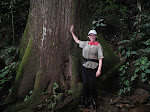
Friends everywhere, please raise your glass today in honor of our dear departed neighbor and friend in Costa Rica, Dr. Robert Muller. Described by Margaret Mead as the most brilliant man in the United Nations, Robert Muller tried to change the world – bringing world peace, by setting an example – and he did it in both large ways and small ways. Nate Perkins wrote an excellent history and tribute to Robert Muller in the Tico Times this week. As one of the co-founders of the University for Peace, Robert Muller set about the task of planting thousands of trees at the University, as well as allowing natural regeneration of forest on pastureland. How can we, as individuals, make the world a better place? Muller described the ways in the thousands. And he shared those thoughts with countless readers around the world over the years. Very best wishes and love to Barbara and the children at this sad time.
Robert Muller’s spirit remains strong in the forest that he helped to regenerate: Zona Protectora El Rodeo, Costa Rica.
Right now, the forest weather is rather cool and misty. Happily though, the flying insects have been damped down by day after day of rain. This is just great pasture weather for the animals. In fact, the horses enjoy the refreshing grazing weather so much, they haven’t returned to the stables for three days! Finally, this morning, Jose fetched them all back to give them some feed, take a good look at them, remind them of the routine, humans,etc. They’re all doing just great.
Also, Lola la Vaca is expecting again, and thriving with her calves out in pasture during this unseasonably cool, misty weather.
It feels like a Scottish highland summer: damp, with frequent drenching downpours, and the sky only clearing to a sort of misty, milky atmosphere that gets everything wet. We’ve had no sun at all for days. It comes out for a few seconds here or there but the clouds quickly swallow it back into the mist.
Solar Power living sure is a lot more fun when the sun is shining! We’ve had no hot water for over a week – I’m getting used to taking cold showers... What’s more, we had a problem with the system, activating the transformer, which only supplies essentials like the water pump and refrigerators. Nothing else works: no television, no lights, no nothing! What an ordeal! Coincidentally, just last week, we gave everybody at the Finca an exercise of thinking about how they would live out in the forest, without any solar power or generator, for an extended period of time. How would we humans survive without power? Everybody got to talking about using wood for fires, collecting spring water – it really gets you thinking about energy consumption when you can’t consume. Luckily, our solar engineer, Carlos Oreamuno from Consenergy comes to the rescue tomorrow. Until then, everybody is prepared for the long haul – even if it means heating the coffee on a wood burning stove.
Also, thankfully, Gerald is in New Orleans. He got out in the nick of time - just before the rest of us had to deal with a landslide, which marooned all the back road farms until the guys managed to dig us out. Then you add in cold showers and no television; yes, Gerry got out just in time...
You will find GRAK quite often at cocktail time at Ryans or Tujagues in the Vieux Carre. Everyday it’s another story.
Home Invasion Alert! We have a pair of wrens trying to invade the house through a small hole up in the sky-roof ventilation. I think they’re the same wrens who nested on the terrace just outside our bedroom a few months ago. Now, with all this rain, not content with bullying the other birds off the terrace, these Rufous-Naped (I think) Wrens want to move inside the house with us! They seem to like the space inside better than outside and don’t care how much we holler at them. They just scold us right back, with their rapid-fire, "chet, chet, chet", flying around leaving bird droppings all over the floor – until we chase them back out again. And even when they're eventually outside, we can still hear them scolding us. We’ve got to get that hole plugged before all chaos breaks loose around here.
Postscript: The sun came out today! Took the horses out. Everybody is smiling and talking about the sun. What an absolute joy!
Monday, October 04, 2010
Wednesday, September 29, 2010
Another Landslide
The road caved in up the mountain near the sign that says: "Calle sin salida. No pase."
The guys have been working all day to clear the mess. And it's just miserable work in this drenching, unrelenting rain. Many thanks to the Gloors for the truck and Jorge and Alirio for helping to clear the road.
Oh the joys of tropical living!
The guys have been working all day to clear the mess. And it's just miserable work in this drenching, unrelenting rain. Many thanks to the Gloors for the truck and Jorge and Alirio for helping to clear the road.
Oh the joys of tropical living!
Friday, September 24, 2010
Finca Meeting, Mozote and Camouflage Artists
When things seem to flounder a bit in life, call a meeting. Sit down at the table with your spouse, kids, or work companions. Set an agenda, and you won’t believe the things you can accomplish...
Here we are, all the Finca personnel, sitting down with a glass of mozote, a very rural Costa Rican drink, discussing more efficient ways to capture and use rain water, conserve energy, implement integrated pest management during the rainy season, plan for the dry season, review maintenance routines and suggest ways to reduce costs. We all learned from each other. Marcia provided an excellent review on mosquito control that nicely tied right into recycling and overall tidiness. And we drank mozote! It was delicious!
Recently, Luis Poveda reminded us of the importance of mozote! I regarded the plant (Triumfetta spp., F. Tiliaceae) as a medicinal – used to treat mostly gastrointestinal complaints. However, Poveda recently reminded us that mozote – a mucilaginous plant* – is also highly beneficial for intestinal health. It’s like an emollient for your insides! The locals make a drink from it and enjoy it regularly to maintain intestinal health! So, the next day, Armando cut a couple of mozote stems, brought them back to the kitchen, and taught us girls how to make the mozote drink. The plant grows very well in the meadows at El Tigre. However, once the meadow (charral, or abandoned pastureland) regenerates past the scrubland stage and grows into a forest, the meadow plants, including mozote, get shaded out and die. So, to prevent this from happening, we deliberately maintain some of the meadows, where the mozote plant thrives, along with other edible plants, like chan.
Here’s Marcia pointing out the mozote bark. The procedure for making the mozote drink begins by scrubbing the stem and then cutting and removing the outer bark. Inside, you can feel a mucilaginous layer, which you then peel off, cut into chunks, and place in a jug covered with fresh water.
At that point, you put it in the fridge and leave it soaking for 24 hours. Next day, you can easily notice how the water has thickened. And that is the mozote drink! But, if you want it to taste good (it has no real taste by itself) you can toss in a few herbal nutrients or fruit juices. For example, this time we made a separate herbal infusion (Stevia, to sweeten the water; a variety of mints; and pineapple sage) and, just before serving, mixed the cooled herbal infusion with the mozote liquid. It was delicious! We all drank two glasses of it (except for GRAK, of course) and walked away from our gathering feeling just great.
Regarding mozote, Luis Poveda wrote: "Muy estimada Victoria, recuerde que el mozote se puede mezclar con limón ácido y grape fruit, sabe delicioso también con naranjilla, carambola, casy otros frutos, es excelente para problemas de colitis, gastritis, estrenimiento y refrescante."
Gracias Maestro!
Take a look at this amazing camouflage artist. This insect looks just like a leaf! I took a picture of him here being held by Yaneth, and then another of him hiding in the hibiscus foliage. Can you see it?
*Mucilages are hydrocolloidal polysaccharides. I found the following description in ‘Herbal Medicine’, by Rudolf Fritz Weiss, MD: “Mucilaginous plants owe their name to the fact that they contain slimy substances. The slime or mucilage envelops and protects badly inflamed mucous membranes, including those of the stomach. At the same time they have a bland effect, binding gastric acid and irritant decomposition products.”
Here we are, all the Finca personnel, sitting down with a glass of mozote, a very rural Costa Rican drink, discussing more efficient ways to capture and use rain water, conserve energy, implement integrated pest management during the rainy season, plan for the dry season, review maintenance routines and suggest ways to reduce costs. We all learned from each other. Marcia provided an excellent review on mosquito control that nicely tied right into recycling and overall tidiness. And we drank mozote! It was delicious!
Recently, Luis Poveda reminded us of the importance of mozote! I regarded the plant (Triumfetta spp., F. Tiliaceae) as a medicinal – used to treat mostly gastrointestinal complaints. However, Poveda recently reminded us that mozote – a mucilaginous plant* – is also highly beneficial for intestinal health. It’s like an emollient for your insides! The locals make a drink from it and enjoy it regularly to maintain intestinal health! So, the next day, Armando cut a couple of mozote stems, brought them back to the kitchen, and taught us girls how to make the mozote drink. The plant grows very well in the meadows at El Tigre. However, once the meadow (charral, or abandoned pastureland) regenerates past the scrubland stage and grows into a forest, the meadow plants, including mozote, get shaded out and die. So, to prevent this from happening, we deliberately maintain some of the meadows, where the mozote plant thrives, along with other edible plants, like chan.
Here’s Marcia pointing out the mozote bark. The procedure for making the mozote drink begins by scrubbing the stem and then cutting and removing the outer bark. Inside, you can feel a mucilaginous layer, which you then peel off, cut into chunks, and place in a jug covered with fresh water.
At that point, you put it in the fridge and leave it soaking for 24 hours. Next day, you can easily notice how the water has thickened. And that is the mozote drink! But, if you want it to taste good (it has no real taste by itself) you can toss in a few herbal nutrients or fruit juices. For example, this time we made a separate herbal infusion (Stevia, to sweeten the water; a variety of mints; and pineapple sage) and, just before serving, mixed the cooled herbal infusion with the mozote liquid. It was delicious! We all drank two glasses of it (except for GRAK, of course) and walked away from our gathering feeling just great.
Regarding mozote, Luis Poveda wrote: "Muy estimada Victoria, recuerde que el mozote se puede mezclar con limón ácido y grape fruit, sabe delicioso también con naranjilla, carambola, casy otros frutos, es excelente para problemas de colitis, gastritis, estrenimiento y refrescante."
Gracias Maestro!
Take a look at this amazing camouflage artist. This insect looks just like a leaf! I took a picture of him here being held by Yaneth, and then another of him hiding in the hibiscus foliage. Can you see it?
*Mucilages are hydrocolloidal polysaccharides. I found the following description in ‘Herbal Medicine’, by Rudolf Fritz Weiss, MD: “Mucilaginous plants owe their name to the fact that they contain slimy substances. The slime or mucilage envelops and protects badly inflamed mucous membranes, including those of the stomach. At the same time they have a bland effect, binding gastric acid and irritant decomposition products.”
Saturday, September 11, 2010
Squeezing out Torsalos: a Tropical Pastime…
Here’s the first of a few pictures showing Armando squeezing a torsalo out of Eddie the Beagle. I have written about Botfly larvae before and, no doubt, will do so again. Torsalos are part of tropical life, especially if you own dogs or cows. They are not something to fear – you just have to learn the life-cycle and deal with it. If you don’t want to deal with torsalos while visiting Costa Rica, don’t let the mosquitoes bite you! The vector for Botfly larvae is the mosquito!
You can Google lots of information on Botflies but, in a nutshell, the cycle starts when a mosquito that is carrying Botfly eggs lands on a dog, bites and feeds - and at the same time deposits Botfly eggs onto the skin. If the conditions are correct (hide thickness, etc.) larvae hatch under the skin and begin feeding on the host – in this case, our Beagle, Eddie; the larvae then grow under the skin and, after a period of time, drop out onto the soil, shortly thereafter turning into Botflies, thus completing the cycle. I have read that some entomologists have allowed Botfly larvae to develop undisturbed under their skin, but I don’t know of anybody who has done it. Everybody we know in Costa Rica feels exactly the same as we do about torsalos: kill them! Squeeze them out! Break the cycle! But make sure you know what you are doing!
If you don’t know how to squeeze the larvae out completely intact and alive, then don’t even try! You could make a mess of it, causing a major inflammatory reaction and infection. I suspect that messed up torsalo extractions account for a big percentage of visits to the vet. Every rural village, however, has an expert in extracting torsalos! In our case, it’s Armando. It just takes him a few seconds to massage the larva into position and then he just pops it out! If you don’t know somebody who can do that, then take your dog to the vet! And remember, there could be multiple larvae!
In our experience, we have rarely seen torsalos in cats or horses. Some dogs get pestered more than others. Why? Because some dogs let the mosquitoes bite them! Watch your dog when a mosquito buzzes near him. Most dogs will whirl around and snatch the mosquito, snapping their jaws shut; snatching it right out of the air and eating it! But mosquitoes do not let sleeping dogs lay and, unfortunately, Eddie falls into a deep slumber after a big meal - this is the second torsalo Armando has squeezed out of him this week! And he does not like the procedure one bit. The other dogs are so patient, understanding that we’re trying to help them; they sit quietly and bear the discomfort as Armando squeezes away - but not Eddie! When we have to squeeze a torsalo out of Eddie, it’s a major production. We need at least two people to hold him still and keep him from biting at Armando! As soon as Armando starts extracting the torsalo, Eddie starts to struggle and agitate, howling the whole time at the top of his lungs - and he’s strong! In fact, he twisted and agitated so much, that I had to put down the camera and help Yaneth with him, so that Armando could finish the job!
At last, done! Here’s a shot of Armando holding up the intact, living torsalo he squeezed out of Eddie. Most dogs actually eat them! As always, Eddie instantly felt relief. I massaged the area a bit with a dab of herbal cream with camphor, and Eddie trotted off to join the other dogs for breakfast. Some sources recommend suffocating the larvae, by putting Vaseline or some such goop on the skin over the air-hole to facilitate extraction, but I think that works better on humans than dogs because they just lick everything off.
For Lola la Vaca and her calves, we use the ‘big gun’: injectable Ivermectin, which kills both internal and external parasites, including torsalos. We also regularly bathe all the animals – forest living requires a multi-pronged approach in dealing with ‘plagas’ for both flora and fauna. In general, the lazy organic gardener’s approach – and perhaps the most effective in the long run – is the food-chain. If you see lots of grasshoppers chomping down this season, just watch the birds fly in!
Gerry’s just back from New Orleans. Go Saints! It looks like they’re still doing their Second-Half Magic! As always, we unloaded the suitcases full of goodies from the States not easily got here in Costa Rica. Years ago, we hauled back stuff like horseradish, but now Costa Rica sells all sorts of interesting edibles. However, even now, there are still things we have trouble finding, which must be hauled back from trips abroad. This trip, when Gerry had purchased everything on our mechanic’s list needed for our Jeep Grand Cherokee, his luggage was notably over the weight limit, even after splitting the stuff into two bags! I could forget my electronics wish list and everything else…
He didn’t notice what I had done to the hedgerow until the following morning. And, like everybody else who comes from the north, upon viewing the scene depicted in this picture, he believed that I’d gone completely bonkers – massacring our gorgeous, flowering hedgerow. Why not leave the hedge to grow and age, like the magnificent hedgerows all over the English countryside? Because we live in the tropical world – in a forest, with only a small clearing carved to allow in sufficient sunlight for solar living. You have to prune shading plants away from your solar panels! This is a major cause of power drop when consumption remains the same, especially during the rainy (growing) season.
There have been so many rainy, cloudy days this season, that the few sunny hours we do get become highly coveted. We need to maximize as much sun as possible for the fruits and vegetables planted in our small clearing. However, in the meantime, the shrubbery has grown and sprawled, shading and keeping areas damp. It’s the September ‘Menguante’ – time for a major pruning! The hedgerow is actually known here in Costa Rica as a ‘living fence’, comprised of plants that accept and even thrive from a right proper pruning! Our hedgerows are made up mostly of Megaskepasma erthrochlamys, Gliricidia sepium and Dracaena species (locally called Itabo and Cana india), along with a scattering of Bursera simaruba. All of these plants and trees not only thrive with pruning, but you can plant the pruned stakes right back into the hedgerow, making the ‘living fence’ even thicker and less penetrable than before. Thus, we keep the dogs in! And we let the sun shine in!
Sunday, August 15, 2010
Kids to the Waterfall, Big Spiders, Grapes, etc.
Happy Mother's day to all you moms out there. Here's a shot of Yaneth - Celebrating Mother's Day weekend by hiking to the waterfalls with Armando and El Tigre Kids. I took this shot after they all got back - not a hair out of place.
Armando was supposed to guide Luis Poveda and some University students down to the old forest, but stuff always happens… So, instead, Armando guided all the kids down to the waterfalls. Yaneth went too – it was her first time trekking to the magical place – what a way to spend Mother’s Day weekend! I couldn’t go because my clavicle still isn’t strong enough; you have to rock climb down there, so you need strength and agility. Armando has learned over the years how to guide people safely – and kids are naturally agile!
Karla took all the waterfall pictures this year; she’s a natural artist. It’s such fun looking at pictures of something as beautiful as the waterfalls – a place I know very well and love – seen from a different perspective, through the lens of someone else, in this case, Karla. Great pictures, Karla! You captured the day from beginning to end; I really felt that I was with you all! I’ve selected a few of the 165 pictures taken yesterday and posted them here, just for the memories…
Take a look at this furry fellow! Magnificent, isn’t he? Actually, it could be a female – they are normally larger and friskier than male arachnids. But one thing’s for sure: this is the biggest tarantula I’ve ever seen! Not that I see them often... They generally burrow below ground or hide in trees during the day and emerge at night to hunt. But this particular spider came up on our terrace the other night, probably to escape the rain. However, he almost didn’t survive the following morning. One minute he’s slumbering peacefully along with Fea, inside her cat-nap box, and next thing you know - here comes housekeeping! Marcia took one look at it and chased it out of Fea’s box, brandishing a can of Baygon (we use Baygon only sparingly - for emergencies only - defined by the observer). The spider scuttled off fast, climbed up the wall and around the house, Marcia right after him with the spray. But he got away and Marcia returned to her tasks - out of sight, out of mind.
Later, when I returned from my walk, Marcia told me about this huge spider she’d chased off and, of course, I just had to find it and see for myself!
So, after a bit of searching, Marcia discovered him hiding under the gas tanks. He was still alive, but he was moving somewhat languidly, definitely no longer up to speed. Most insects would have been killed instantly with just a whiff of Baygon, but this was a big tarantula. Armando looked at it gravely and announced that some of these species are venomous! Apparently, tarantula bites hurt more than the venom, but their urine is caustic! Still, we all agreed that this was a magnificent specimen. We left him alone until the next day, when we found him still alive. Yaneth, who has a way with spiders, just picked him right up, placed him in the sink and rinsed him off for a few photos. He still appeared languid, however. Would he survive? There was only one way to find out. Yaneth put him back in the garden on the ground and after a few hours, he began to move away. The next day he was gone – back to the forest. I suspect that we won’t see this furry fellow again, no matter how cozy he found Fea’s cat-nap box.
Fea is known for keeping strange bedfellows! Here’s a shot of her, our 23 year old Persian feline. We rescued her years ago in Pennsylvania and brought her with us to Costa Rica. We figure she’s on her eighth life at this point – stung, bitten, poisoned, fallen, and nearly died over and over again, but she survived it all. Now the old girl totters around the grounds like the Queen Kitty – all the other household animals, and humans, regard her with reverence. There is something special about the old girl. Needless to say, Fea is groomed and pampered daily, but she much prefers going right back outside where the world is so much more interesting than inside the house. It’s quite normal to find her napping in the midst of insects, all giving way, leaving her in peace. Nothing bothers her anymore. But she is the exception. Forest life is not easy on animals, especially during the rainy season.
Take a look at our new pup, Zinc, shown here romping with Danny. Zinc the Pup replaces our beloved Zaguate, Zinc the First, lost to the forest a few months back. Like the late Samantha and then Spotty, Zinc had a fatal hunting instinct, though he survived a lot longer than we expected. The forest took his sister Maggie some years before. And finally the forest took Zinc. Luckily, the other dogs are more territorial, having a stronger instinct to please and stay near the house. Thus, they survive; only suffering from the normal ailments that every other dog owner deals with. Sol got a sore that wouldn’t heal, so we took her to the vet, who removed a tumor, and she is now on the mend. All the other animals are currently doing well. However, with this relentless rainy season, we are constantly battling parasites and biting insects – rotating repellents and other remedies. The chickens really help! They scavenge for grubs all through the stable area, and follow Lola la vaca and her calves all over the place. And then, when the animals head out to pasture, other birds take over as insect-eating escorts.
Here’s a shot of Luis Poveda collecting native, forest grapes (Vitis tilifolia) ripened on the vine. There is a very short window of opportunity to collect them before the birds get them. He filled two bags and took them to the University to conduct an analysis of their nutrient value. Poveda is attempting to quantify the nutrient and medicinal properties of plants, in order to use the information to convince Costa Ricans to rediscover the value of the flora growing where they live. Why purchase imported spinach, when you can grow and eat the wonderfully tasty, nutritious, and native, Chicasquil or Zorrillo?
Here’s a shot of Chicasquil (Cnidoscolus aconitifolius) - an easy to grow shrub that does well in the smallest of gardens. Everybody should grow one or two! There is so much to eat in the forest – you just need to know what and how. We even collected a bunch of Eugenia cartagensis berries and produced a very nice liqueur! GRAK suddenly became interested in botany at that point…
Another time, Poveda showed up with a post-grad chemistry student, William Zamora, from the University of Costa Rica, and they collected Zanthroxylum monophyllum for analysis at the lab. William is also interested in Croton draco (Targua) sap, renowned for treating gastritis, amongst other ailments. We plan to collect the sap during the waxing moon (local tradition) and take it to him at the U. I’m keen to check out how they set up large-scale distillation equipment. We’ve got hundreds of citronella and lemon plants growing at El Tigre, which require distillation to collect their essential oils – key ingredients for concocting insect repellents.
Here’s a shot of Targua in bloom, with a curious transparent butterfly; just one of many butterfly species taking part in the pollinating frenzy of a blooming Targua! This is high season for butterfly watching – it’s just a magical scene all through the gardens. The flowering Targua attracts a huge number of pollinators – it is literally covered with fluttering colorful butterflies and insects. The tree seems to come alive with moving, buzzing life.
Take a look at the fruiting Sipuruna guianensis. If you rub the fruit, it smells just like a lemony citrus! But it’s not in the citrus family – it’s a Monimiaceae. We have many Sipuruna trees fruiting right now in the forest understory. I sure wish I could figure out how to extract the fragrance…
Here’s a shot of Armando planting Dalbergia retusa (Cocobolo) in charral near the house. Rain, rain, rain – everyday it’s the same. No canicula for Costa Rica this year. Gerald is just miserable with the dreary weather and biting insects; they are just terrible this year, the worst ever! On the bright side, we have a longer planting season. Armando collected a bunch of Cocobolo seeds last season and germinated them in the green house. We planned to keep them for another season but the roots quickly filled up the bag – time to put them in the ground. We would normally never plant so late in the season, but it’s been so wet this year. The trick with trees in the legume family is to hide them from the foraging horses. Armando found spots within the charral as, in our experience, hardwoods do best planted in charrals with companion plants, rather than all alone out in pasture. Don’t remove pioneers, like Cecropia or Tuete, to make room for ‘high value’ trees. Every tree has value! The Cecropia, during its short life, will protect and enable slower growing trees to survive! Tuete (Vernonia triflosculosa) - an effective coagulant - is a very useful companion plant because it attracts and tolerates insect attacks, allowing tender seedlings to prosper. There are so many more examples of companion plants – always think biodiversity…
Tuesday, July 13, 2010
Breaking Bones in Paradise
Here’s my reflection in a sling, taking a shot of a colorful flying insect.
Gerry asks, “What is it about women breaking collar bones?” Krysia, a horseback rider pal, wrote that she sure knows how it feels to break a clavicle! Karen wrote that she’d broken her clavicle when she was seventeen and still walks around with a metal plate and four screws. My Swiss neighbor, Gabriela, broke her clavicle when somebody hit her with a golf ball (she had her metal removed after a year). She said that you can always kind of feel the metal afterwards in your shoulder and wanted it removed, even though it meant another surgery under general anesthesia. Coincidentally, we had the same surgeon at Cima, Dr. Alfonso Pereira Garcia (who does very nice, neat work, if you ever need the service…). He told me that if I wanted the metal out, then I should call him in about 18 months.
Turns out lots of people I know have broken a clavicle. I guess pretty much all skiers, horseback riders, rugby players and other assorted sportsmen/women have broken something or other over the years. But this was the first broken bone for me after all these years of pushing the high-adventure envelope and, yes, having lots of falls, but no serious injuries, until now.
Breaking News: The President’s husband, Jose Maria Rico, just broke his hip and ended up at – Cima Hospital! This is definitely the season for breaking bones!
I learned how to fall a long time ago, on my 18th birthday. As soon as I reached the age of consent, I signed right up for sky diving, back in Kalamazoo, Michigan, where parachute training was vigorous and military-style (it was the same with scuba diving training there – they wouldn’t even accept you into the course if you couldn’t swim six laps in an Olympic-size pool). They really train you in Michigan - none of those quick, easy, honeymoon courses, like down in Mexico, that get people killed. If you were not pronounced ‘fit’ after all the parachute training, then you were not allowed to jump, not even with the static line. During the training, we novices were taught how to fall, how to use the whole body to absorb the shock, how to roll with it! We had to jump off a high ledge and practice falling, over and over again, until it became second nature. Sky diving is definitely good training for anyone wanting to learn how to fall without injury.
So, over the years, I have called upon that old training to conquer the fear of falling and going with it; rolling right back up and landing on my feet. However, the time when my horse Matchi threw a shoe, we both went flying, and he fell on top of me, it didn’t help at all… I went to X-ray my shoulder at Cima but, luckily, it was just a bruised scapula. Over the years, a number of friends, who have visited me here at El Tigre for hiking, have gone home via Cima Hospital too (bruises, broken bones, heatstroke, etc.) taking memories and hospital bills with them! Unfortunately, accidents happen in the jungle...
But this fall was just plain stupid. I was coming down the stairs, like I’ve done hundreds of times in the past, happy as a lark. Gerry and I were going out to dinner on Saturday night to celebrate the fact that it wasn’t Friday (He’d had a rough Friday, shuffling me back and forth from the Pro-Nativa Conference, held all the way across town (the other side of the world, according to GRAK) in the beautiful Hotel Bougainvillea.
Shot of lovely, native Palicouria species.
It was an outstanding first Conference for Pro-Nativa – all serious gardeners and landscapers in Costa Rica should study this important trend in landscaping. Look to your own garden first, and open your eyes to the treasures provided – birds dropping seeds: a beautiful fern, a Gesneriaceae species, a Piper? Some might call these volunteers, ‘monte’ (weeds). But weeds are just plants in the wrong place. Maybe that weed belongs there more than what YOU planted there! And it could be more beautiful and easier to take care of!
Take a look at the forest and woodlands nearby where you live. Can you possibly improve on such beauty as Mother Nature provides? Pro-Nativa says no. Watch the press and literature for conferences coming to your area. You might meet the authors of your favorite botanical reference books: Willow Zuchowski, Barry Hammel, Deedra McClearn and others; passionate promoters of native plants in the garden. Native flora also attracts a breathtaking array of native fauna, creating something approaching perfect serenity, uplifting the spirit.
But I digress. I was planning on going out and having a wonderful Saturday night dinner with my long-suffering husband. It was dark. Walking down the stairs, I thought I’d reached the bottom step. But, no! When I turned right to walk over to Gerry, instead of stepping onto the floor, I walked out onto – air! As my body then began to roll to the left, it slammed into a column, collar bone first... It hurt a lot and Gerry said it didn’t feel right. So, we agreed to stop at Cima on the way to dinner to get it checked out. I figured, if the usual occurred (ER, X-ray, Orthopod prescribing sling/analgesics) then we would be out and on our way to dinner within the hour. Well, it didn’t quite turn out that way…
The X-ray showed a diagonally broken clavicle with a large space between the two pieces of jagged bone. It was a shocking sight to look at but what came next shocked me even more. The orthopedic surgeon could not just maneuver the two pieces back together again. He would have to cut my shoulder open, put a titanium plate on top of the bones, and hold the pieces together with titanium screws! Simple as pie! He could get time in the operating room at 11 p.m. that night. He just needed to phone a few people: another surgeon, an anesthetist, an internist to check me out and see if I was fit for surgery, etc. When had I last eaten something?
I was ready to bolt! No, I didn’t want surgery! I went through open-heart surgery twice as a kid. It saved my life but the experience changed me forever. I don’t like to get cut. I don’t like needles, the smell of alcohol, hospitals…
Gerry showed up at that point and concurred with the surgeon, as it was obvious that the bone would not heal without surgery. So I did end up in surgery, and Gerry had his Saturday night dinner alone, long after midnight, at a local McDonalds. He hasn’t been to a fast food joint in years. I can just imagine him, sitting in a McDonalds crowded with adolescents out on a Saturday night, eating a ‘Quarter Pounder with Cheese’ all by his miserable self, while I got surgery costing us plenty because of a really dumb accident. Yeah, I know, now I really owe him!
After the surgery, I had to spend the night at Cima, so missed the catholic procession in El Rodeo on Sunday, and also missed the Peace Festival taking place in Ciudad Colon. It’s not easy getting discharged from a hospital. I wanted to leave as soon as I woke up in the morning, but had to wait until I got another x-ray and a visit from the surgeon. However, we pushed and pushed and eventually got things moving more quickly. No, I didn’t want to choose from the menu for lunch – I didn’t want any lunch at all! I WANT TO GO HOME NOW.
We finally got out of there, after paying the bill of course: $7,000. And as we were leaving, just for another turn of the knife (or scalpel) as it were, the internist hurried over looking very concerned. Apparently, we were leaving so fast, he’d not had a chance to bill us for his services…
And now Gerald has another project to keep him busy: extracting money from our insurance company…
Here’s a shot of Karla and her 15th birthday cake. We used a cheesecake recipe out of a wonderful Southern Living cookbook that Beth Crane gave me some years back – still my all-time favorite when searching for something extra special. As turning fifteen in this country is a special birthday, Karla is doing exactly what she likes – for a while, at least! Hiking and riding! It’s school summer holiday here, so on Monday, a group of kids set out for a six-hour hike down to Piedras Negras and back. And all the dogs went with them for some long needed exercise.
This morning, the Finca kids went out horseback riding, with Jose guiding them. Of course, I stayed home being miserable with the sling, but was glad to learn that both kids and horses had a wonderful time. The horses appear to enjoy going out as much as the riders!
Later, Gerry grilled hamburgers and we feasted on cheesecake for desert. This was my first appearance in public since getting the sling – albeit just in the kitchen, and only with the El Tigre ‘family’. But it felt just wonderful to laugh and get teased.
Gabrielle, our neighbor, called from Switzerland to wish me well, and told Gerald to treat me kindly. He responded that he was already well-established in his new role of slave – cooking, cleaning, running errands – all for his ill-tempered, complaining, ungrateful wife. Oh how our poor spouses suffer!
But, truly, everyone is treating me very well. Yaneth made me pupusas, fresh bread and yoghurt. Margarita sent over some delicious guayaba preserves. Abby sent me flowers! Jorge brought me over a bag full of the latest delights to feast on from Paoul and Gabrielle at Finca Hamadryas (granadillas, tiny sweet bananas, chayote, and creamy avocados). Armando brought basketfuls of citrus and herbs from the garden, so we made a delicious iced tea with some of the herbs: clove basil, spearmint, chocolate mint, pineapple sage and stevia. And he even planted a new rock garden that I could view just outside the window, using native ferns and plants brought up from Cerro El Tigre!
Ornamental bananas and Zingibers are now producing beautiful fruits and bracts. However, both are considered invasive (a la Pro-Nativa Conference). So what do we do? Well, Armando cut armfuls of them to take to the local procession on Sunday and for display at our charming church in El Rodeo, later to be safely composted.
Just outside the house, Jose cut a nice raceme of still green bananas and left it on the ground to ripen, as usual, along with several ripe, yellow bananas, sitting alongside. I figured he’d left some of the ripe bananas for the monkeys. But, would they show? Sure enough, hours later, a troupe of capuchin monkeys came up from the forest to help themselves to the oranges and bananas in the garden. Now, here’s a piece of (fascinating?) information that you can use at your next cocktail party. Capuchins actually peel bananas before eating them, dropping the peel onto the ground. But they don’t peel oranges; they pound them on a branch to soften them and then just bite into them, sucking out the flesh and juice. I have a great bird’s-eye view of the monkeys feeding from our bathroom window. They don’t like being watched, however. So I have to do it furtively, like I can’t really see them. And then they glance away, like they can’t really see me. Even though we can see each other perfectly well, we just act like we can’t. That’s monkey etiquette...
Birds don’t like you watching them either when they’re feeding their nestlings. Some wrens built a big nest just outside our bedroom balcony, and they’ve provided us with many hours of entertainment. Although, if we go outside on the balcony to watch, they scold us - Hey! Hey! Hey! Get out of here! - until we retreat back inside. Only then do they resume feeding the nestlings. Then one day they were all gone! The fledglings had left the nest (flown the coop?).
Finally, thanks so much to everyone who wrote and called! It really means a lot! I still can’t write much because it’s not easy writing with my right hand – I’m a leftie. Barry says using the other hand builds new neuronal connections, but it just makes me feel stupid and awkward!
Tuesday, June 22, 2010
Life is a Bowl of Lemons
GRAK requires lemons (not limes, heaven forbid) for his Gin & Tonic – a key ingredient for a drink ever so necessary for tropical forest living (water, quinine, juniper berries, alcohol, citrus) and all so fortifying for the constitution! Thus, we grow three varieties of yellow lemons at El Tigre. Here’s a shot of them – Barry Hammel knows their individual names, but one variety looks very similar to the yellow lemons you can buy in stores up north. Why do we grow them here? Well, you can find green limes and sour oranges at grocery stores everywhere, but the only semi-reliable place for buying yellow lemons, other than very occasionally at local markets, is from a guy in the cellar of the Central Market in downtown San Jose. In our experience, the big ugly variety goes off the fastest – the peel soon gets covered with a kind of greenish-white mold, if not refrigerated quickly. The other two varieties will last just as long as the more common limes and sour oranges - up to several weeks at room temperature here in The Tropics. We grow many of the citrus varieties- green, orange, sweet, sour - but only a slice of yellow lemon will do in Gerry’s Gin & Tonic at the end of a long day…
Marj and Dave playing with Lemons!
Gerry has been grumpy since returning from New Orleans. It has been overcast and rainy just about every day, all day long. Usually, Costa Rica gets a morning sun during the rainy season – ample for charging up the batteries via the solar panels. But weeks on end of cloudy days and rain requires generator backup – for us at least 3 hours every day or two to cover our electricity needs. We started a Captain’s Log – daily tracking of the weather, solar energy system and generator back-up use. It helps us to stay on top of the situation and, at this point, after five years of living ‘off-the-grid’ on solar power, we have all become solar engineers (with the invaluable help of our real solar engineer, Carlos Oreamuno). This is especially true of Armando, who maintains it all with his own log and notes. It’s all part of living life in the jungle...
One reason for Gerry’s grumpiness is that the rain brings more insects! And insects bite; and they seem to have a penchant for his nice, sweet blood; and bites itch; and multiple itchy bites make him irritated and grumpy…
We do keep a sharp eye out for mosquitoes – just occasional pests so far, but if one exists in the house, it will go straight for GRAK. We try to break the breeding cycle to keep the population down, by keeping the drains clean and all water flowing. Dengue is the enemy!
However, many of the insects in this forest are colorful, fascinating creatures - and they attract lots of birds! All birders will tell you that if you want to see birds, go look for insects and fruiting trees. We have seen large flocks of parrots and parakeets recently, some visiting from the Parque Nacional Carara, joining the resident birds to feast on the Aguacatillos – little avocados – now fruiting. The parrots chatter loudly in flight and continue chattering, even after they land and settle down to feed. Then, after feeding quietly for a short time, the chatter begins again: starting with a complaining pair; followed by others who join in to chatter, scold and natter; and then the racket continues increasing to a great, noisy crescendo until, finally, the whole flock flies off in a cacophony to another tree.
Other species call and sing, keeping the music going all day, especially during the rainy season. Birders can identify and locate birds by ear: Toucans, Oropendulas, Trogons, Wrens, Warblers, Fly Catchers; we have them all here, and many more - all with distinctive voices joining in the chorus. The Masked Tityra also returned to El Tigre this year. And there is a lot for them to sing about, with so many trees fruiting right now: Ficus, Ingas, Cupanias, Jacartias, Casearias, many species of Rubiaceae, Solanaceae and Myrtaceae, and that’s just for starters!
And there’s not only fruit and insects to eat. Armando actually saw a Mot Mot snatch a Coral snake out of a stone wall and chomp it down!
Here’s a shot of Armando and me discussing the ripeness – hear them shake? – of the Apeiba tibourbou seeds.
Here’s a shot of a Dalbergia retusa seedling that Armando raised from a seed collected from Cerro El Tigre. Most of the seeds germinated and now we’re planting a bunch of Cocobolo! We also planted/donated arbolitos from Armando’s vivero of Bernoullia flammea, Carapa guianensis, Ceiba pentandra, Citrus species, Diphysa Americana, Garcinia intermedia, Guarea glabra, Hura crepitans, Lafoensia punicifolia, Samanea saman, Swietenia macrophylla, some native fruiting trees and a slew of native plants brought up from the forest for cultivation. We are especially pleased with the lovely Palicouria and its yellow flowers.
Thanks to C.N.F.L. for the seedlings we received, that were donated as part of their Virilla River & Watershed Reforestation Project. We planted Cedro Maria, Guachipelin, Laurel Negro and Caoba.
Here’s a shot of Armando in the vivero. Rainy season is also great for growing lettuces (Asian lettuces – Bok Choy, etc., do great in this climate) and many other edibles of all sorts. We’ve had to move some of the Mediterranean herbs under cover – lavender and rosemary will wilt quickly under direct tropical rains. Armando has gained a lot of experience planting in small clearings above the orchards, as ‘organic’ means rotating crops and spots! In general, we have learned that the best success in the garden comes by planting natives. Armando actually planted a shrubbery of Chicasquil – a nutritious, tasty shrub, with a flavor kind of like spinach! He has also succeeded in propagating many varieties of chili peppers, all thriving even during the rainy season. And, yes, we make lots of salsa!
Here’s a shot of Lola La Vaca with her second calf, ‘Little Gerry’, out in pasture with the horses.
There is no doubt that her milk has improved after giving birth to him. We continue to practice making yoghurt and fresh cheese, but would like some more training on the art of cheese-making. Agustin’s wife Satia’s family – originally hailing from Michigan – live on a farm up near the Cerro de Muerte and have decades of experience making cheese and bread.
Here’s a shot of Karla and Geovanna with our littlest dog, Lulu.
Time flies. Karla turns 15 next month – a very big deal in this country (kind of like ‘Sweet 16’ in the north). It seems like just yesterday that we were celebrating her 5th birthday! But Karla doesn’t want a party – she wants to ride and hike.
Unfortunately, now turning to a topic of disharmony, we’ve had another incident with thieves in the neighborhood! Here’s how it went down. One of our guys, Jose, spotted two thieves breaking into the Muehller’s house down the lane from us. He immediately called one of the Muehller employees, Alexander, who called the police, and then also alerted the other finca workers along the lane, Jorge and Alirio! The police arrived and nabbed the thieves, handcuffed them and put them in the patrol car. Then they drove up to our place to see if they had struck here too! Armando recognized them as the same guys who had tried to break into the brother’s house of our Swiss neighbor, Paoul, some months ago. At that time, they were given a good talking to and told not to come back! We thought that, after Paoul gave the scruffy thugs a dose of his grumpiness – not to mention dealing with all our guys and the Mora Police – we would never see them again! Well, some youngsters learn their lesson, go find a job and earn an honest living; but others… Apparently, they live near the Quitirrisi mountains and know how to quickly move through the countryside and forest. They target unoccupied houses, grab something quickly, and then they’re gone. That’s why the Ticos call thieves of this sort, ‘guatusos’ – animals that live in the forest, move quickly, and are opportunists, darting here and there, snatching this and that and gone in seconds. Pura Vida!

Monday, May 10, 2010
Well-timed Humbling Experience
Whenever I think I’m getting somewhere with Tai Chi, somebody – usually my teacher Patricia – comes along and gives me a good knocking.
Same thing happened the other day in New Orleans! I was out on the Riverfront Green doing HunYuan Chen Style Taijiquan yesterday, as usual, when I noticed a guy standing nearby watching me. I could tell at a glance that he had mastered the art - they always look with open, friendly expressions.
I should mention that, over the years, lots of people have watched for a few seconds as they go on by, running, biking or whatever. And once, another Taiji practitioner actually joined me on the green for a session. But we ignored each other and just did our own thing, and then went on our separate ways without a backward glance. He was much better than I was and I hoped he would return, but he never did. I read somewhere that if you work out long enough out in the park, other Taiji people will eventually join in and soon you have something going.
Well, this morning it was different. I realized instantly that my observer was a high-level martial artist, and he in turn could see that I was still quite new to the art. As I went through Feng’s Hunyuan 48- form, I tried to settle down, relax, unblock, qi, focus, yi…
But it was no use. I made a mess of the form. I was so embarrassed! But when I finished and turned to leave, he addressed me as a fellow student of Taijiquan.
I told him that I was a beginner. Only 10 years. He responded that we are all beginners at Taijiquan. Would I like to see a few seconds of his form? I sure did! So he began, and I instantly recognized the movements of a great master of the martial art - he made it look easy! I felt humbled, mesmerized and eager to learn from this fellow, although time was short. Gerry would be popping over within minutes to collect me for our morning walk to fetch the newspaper***.
We exchanged introductions and talked. It turns out that Ron Panunto has been studying martial arts for the past 35 years and, for the last 15, he has been teaching Tai Chi, all styles - Chen, Yang, Wu and other martial arts. As we spoke, I realized that he deeply understood Taiji concepts and that he pronounced them with well-practiced Mandarin. I’ve been too lazy to study Mandarin but should have a firm understanding by now of Taiji basics – not just pronounced correctly but actually applied. I needed to meet this guy.
He pointed out several key problems I have and quickly put me on course to improve my structure and form, helping me grasp internals that I’ve been working on for years! I learned more in 5 minutes from this guy than I have working out on my own for the last 3 years. It was a humbling experience – I have a lot of work to do! And there I was fantasizing about going to Beijing and training with Feng!
Thank you Ron! Your 5 minutes gave me lots of work to do!
If you live near the Philadelphia area and want to study Tai Chi with somebody who has not only mastered the art but can convey the teaching, check out Ron Panunto.
***I should mention that hubby Gerry often watches me do the form, wherever we are in the world. He’s my hero! One time, we were just out walking in the square in Managua when two thugs attacked us! One knocked me down and I could hear Gerry just kicking and punching and sending them both flying! When it comes to safety, I look to Gerry more than anything I could do with Tai Chi – even though I practice a martial art. I still can’t fight when attacked. Thank God for Gerry!
Meanwhile, New Orleans is under threat from the oil spill. More areas were closed to shrimping today.
We watch ‘Treme’ on HBO, Sunday nights at 9 p.m. and recognize a lot of people in the show: Derrick Freeman, Kermit Ruffins, Troy Andrews, John Boutte and many others. We also recognize well-known New Orleans characters, played by actors like John Goodman. This is a New Orleans story and we are riveted! Remember the first season of ‘24’? ‘Treme’ is another world, equally as riveting. It is recent history unfolding – and everything just comes back.
Same thing happened the other day in New Orleans! I was out on the Riverfront Green doing HunYuan Chen Style Taijiquan yesterday, as usual, when I noticed a guy standing nearby watching me. I could tell at a glance that he had mastered the art - they always look with open, friendly expressions.
I should mention that, over the years, lots of people have watched for a few seconds as they go on by, running, biking or whatever. And once, another Taiji practitioner actually joined me on the green for a session. But we ignored each other and just did our own thing, and then went on our separate ways without a backward glance. He was much better than I was and I hoped he would return, but he never did. I read somewhere that if you work out long enough out in the park, other Taiji people will eventually join in and soon you have something going.
Well, this morning it was different. I realized instantly that my observer was a high-level martial artist, and he in turn could see that I was still quite new to the art. As I went through Feng’s Hunyuan 48- form, I tried to settle down, relax, unblock, qi, focus, yi…
But it was no use. I made a mess of the form. I was so embarrassed! But when I finished and turned to leave, he addressed me as a fellow student of Taijiquan.
I told him that I was a beginner. Only 10 years. He responded that we are all beginners at Taijiquan. Would I like to see a few seconds of his form? I sure did! So he began, and I instantly recognized the movements of a great master of the martial art - he made it look easy! I felt humbled, mesmerized and eager to learn from this fellow, although time was short. Gerry would be popping over within minutes to collect me for our morning walk to fetch the newspaper***.
We exchanged introductions and talked. It turns out that Ron Panunto has been studying martial arts for the past 35 years and, for the last 15, he has been teaching Tai Chi, all styles - Chen, Yang, Wu and other martial arts. As we spoke, I realized that he deeply understood Taiji concepts and that he pronounced them with well-practiced Mandarin. I’ve been too lazy to study Mandarin but should have a firm understanding by now of Taiji basics – not just pronounced correctly but actually applied. I needed to meet this guy.
He pointed out several key problems I have and quickly put me on course to improve my structure and form, helping me grasp internals that I’ve been working on for years! I learned more in 5 minutes from this guy than I have working out on my own for the last 3 years. It was a humbling experience – I have a lot of work to do! And there I was fantasizing about going to Beijing and training with Feng!
Thank you Ron! Your 5 minutes gave me lots of work to do!
If you live near the Philadelphia area and want to study Tai Chi with somebody who has not only mastered the art but can convey the teaching, check out Ron Panunto.
***I should mention that hubby Gerry often watches me do the form, wherever we are in the world. He’s my hero! One time, we were just out walking in the square in Managua when two thugs attacked us! One knocked me down and I could hear Gerry just kicking and punching and sending them both flying! When it comes to safety, I look to Gerry more than anything I could do with Tai Chi – even though I practice a martial art. I still can’t fight when attacked. Thank God for Gerry!
Meanwhile, New Orleans is under threat from the oil spill. More areas were closed to shrimping today.
We watch ‘Treme’ on HBO, Sunday nights at 9 p.m. and recognize a lot of people in the show: Derrick Freeman, Kermit Ruffins, Troy Andrews, John Boutte and many others. We also recognize well-known New Orleans characters, played by actors like John Goodman. This is a New Orleans story and we are riveted! Remember the first season of ‘24’? ‘Treme’ is another world, equally as riveting. It is recent history unfolding – and everything just comes back.
Saturday, May 08, 2010
The Word is Out
The Word is Out: I am New Orleans’ Biggest Party Pooper
Shot of Margaret, Beth and me in New Orleans.
Margaret and Joe Bellah, Beth and Greg Crane, Jon and Abby all discovered this during the course of their visits to New Orleans for Jazz Fest. The Cranes and the Bellahs joined us for the first Jazz Fest Weekend – Beth celebrating her birthday, Margaret celebrating retirement, all of us enjoying a wonderful reunion not achieved since the old days in Costa Rica. Our old friends planned their trips separately and only later discovered that, by some wonderful coincidence, the visits overlapped. We were all in town together! We tried to coax Nina and Ross to join us but it was all too last minute – this nana of six needs a bit more notice to just go traipsing off to New Orleans with old pals!
Shot of me and Beth on roof.
We had a wonderful time together, and also apart, as our friends explored all over New Orleans.
Another coincidence – everybody scheduled trips during Jazz Fest. We accompanied our visitors most days but had the first rainy day of the Festival to ourselves – where we found ourselves huddling under a rickety Daiquiri tent (daiquiris in hand, of course) for 3 hours, sheltering from the torrential rains threatening to collapse the overhead tarpaulin cover, which was collecting too much water. The guys kept pushing up at it with their umbrellas, hurling great waves of water cascading down the open sides. But we were very well organized – two of the guys held off the waterfalls with open umbrellas to their backs, gallantly keeping the water from reaching the rest of us inside.
Who were we? Why, 30-some people who’d just purchased daiquiris on our way to the Gentilly Stage when the sky opened up. So we parked ourselves temporarily under the tent and listened merrily, if a little damply, to the sounds coming from the stage. Coincidentally, we met a bunch of people from Michigan, and I must say that we had an absolute blast.
When the six of us went to the Festival on Sunday, there was a huge mucky bog in front of the main Acura Stage – as Beth and I found out a little too late! Yuck! But the crowd didn’t care; they were up and dancing in it! We sloshed over to the Blues Tent, the Jazz Tent, Congo Square, the Economy Hall, and so on and on, until we went home mucky and tired but having enjoyed a great day. However, the party was just getting started all over town. Knowing that all the restaurants would be filled to overflowing, we had smartly made reservations a few days earlier at GW Finns, where the six of us feasted on fresh grilled shrimp and the best fish you can find anywhere. That was, of course, before the oil spill happened in the Gulf, making that memory one to cherish even more.
After dinner, the real action starts – you can hear your favorite local artists at small intimate venues (or large trashy ones, if you are so inclined) all over town – extremely important if you missed them at Jazz Fest. And the music goes on all night – the last act at Tipitina’s starts at 2 a.m.
Trouble is, being an early riser and feeling good at breakfast, I am always gung ho when Gerry reads off all the acts playing around town that night: Charmaine Neville at Snug Harbour, Kermit Ruffins at Vaughn’s, The Jazz Vipers at The Spotted Cat, etc. But then the time comes around – normal starting time is 10 p.m. – and, country hick that I am, I just kind of poop out by then and want to go to bed! Everybody stares at me in astonishment whenever I admit just wanting to go to bed, rather than to a club. Yesterday, in fact, several people from Obit just stared at me when I confessed to rising early. What on earth was I thinking? I’m in New Orleans…
Anyway, we still managed to do a lot during the day with our visitors – a street car to the Garden District, then all the way to Audubon Park and Tulane University – much lovely walking there. Yes, I know I had a blister that day and pooped out on that too…
The main message to Jazz Fest goers is, book your restaurants for dinner in advance or you will be disappointed.
When Abby and Jon arrived for the second week-end of Jazz Fest, we got very lucky with a cancellation at Brigstens. More rain arrived also, but we didn’t let that slow us down – at least not during the day. We heard Abby’s brother-in-law, Derrick Freeman, sing and play drums at Jazz Fest with Kermit Ruffins at Congo Square. They must have recorded Derrick’s performance, because we heard him sing it again on the bus ride going home. They then performed again on stage at Rock ‘n Bowl, starting around midnight. We got there around 10 and almost managed to bowl despite the crowds (in fact, we actually started before getting thrown off the lane by the people who had reserved it…). Great music and dancing. Lots of booze. However, I couldn’t make it to midnight to watch Derrick perform with Kermit. So, poor Gerald took me home by taxi. The secret is out: Biggest Party Pooper in New Orleans!
Now for a change of topic and mood. An oil rig exploded out in the Gulf of Mexico and we watched news reports of the search for eleven missing workers (sadly, never found). Then the focus turned to the oil spill – gushing from nearly a mile down below the surface of the sea. It was, and still is, causing high levels of stress as everyone waits, oil pouring inexorably into the Gulf, day by day creeping closer to the shore. Oyster, shrimp, and general fishing are all stopped, and the prohibition area is expanding each day.
Another catastrophe is creeping towards New Orleans. But the best minds are now focused on capping, sealing, relief drilling, burning, etc.
But no, you cannot smell oil in the air in New Orleans, no matter what the news channels say. It’s as if the disaster unfolding close to the south-eastern coast of Louisiana was happening somewhere far off – that shape expanding day by day like an amoeba.
We love this town with a passion and are bracing for the worst, while hoping for the best – first floods and now oil (in Costa Rica it was landslides and fires!). If this contraption they now have to contain the oil works, the whole team will be hailed as heroes. And we need heroes in this world right now.
Sunday, April 18, 2010
Springtime in the Big Easy
We went to the Easter Day Parades – just for the fun of it!
The bright and sunny Sunday morning saw streets full of people decked out in their Sunday best: ladies dressed in lacy layers of chiffon, pastel dresses, with huge, flower-festooned floppy hats, riding to the Cathedral by carriage or convertible; waving to the street crowds; shading themselves with colorful parasols. They even stopped for Mass – and then got back in their carriages for more meandering through the Vieux Carre.
And then came Chris Owens and her entourage, rolling down Royal Street. Dressed to the nines, her traditional Easter Parade didn’t disappoint. Oh, how the crowd appreciated it all – floats, brass bands and marching ponies!
But for the best costumes of all - apart from Chris Owens herself, of course, who always reigns supreme – you must be at the Easter Sunday Gay Parade. We were late for it but, luckily, caught up to them on Burgundy Street. All was merry and joy (and gay)! What costumes! What sauciness!
French Quarter Festival - once an event purely for locals - has been discovered, and it really maxed out this year! Everyone - young, old, kids, dogs - all came together for a three-day joy ride. The first day, we ate, drank, and danced all day to the music. The second day, we ate and danced, but drank just water until 6 p.m., when the hangover started to ease. The third day, I had bailed out by 6 p.m., utterly exhausted, desperately needing to go home. Gerald laughed at me – what a weakling, no stamina – and out he went for dancing and jazz at the Royal Sonesta.
And now, Jazz Fest is coming right up. You must be prepared for the crowds. Relax. Don’t hurry anywhere.
So, what happened to my stamina? Well, I try to keep up with my walking and Tai Chi training, in order to stay conditioned, but…
The first morning after arriving in ‘The Big Easy’, I rise early as usual, 6 a.m., and head out to the waterfront, walking and executing ‘The Form’ - XinYi Hunyuan Taijiquan - on the grassy levee.
Next day, I rise at 7-ish; the following day, 8:30. And then, before you know it, I’m sleeping in until 9:30, coasting to a final wake-up time of 10-ish!
Welcome to New Orleans: a place to sleep late; get up and lounge; take your time; enjoy your coffee, lingering over the experience. Things just get started slooowly; no problem with late arrival. The Jazz Fest crowds stream in all day.
Lately, we have begun to exercise in the early evening - walking the riverfront, prowling The Bywater, cruising Bourbon St…
Wait a minute! Don’t just tourists cruise Bourbon St? Oh, yes, and then some! For the real local music scene, head over to Frenchman Street, or a plethora of other spots all over town. They all get going properly around 10 p.m., but some places also have early shows.
Still, once in a while, after dinner, we go for a wander down Bourbon Street… It’s kind of like going for a drink at the Del Rey in Costa Rica – but, oh, much more so!
Bourbon Street is best experienced between the hours of 8 and 11 p.m. Earlier is okay if you’re with kids, to just get a look at it on the quieter side, although music pours out onto the street all day. But, for that matter, you can listen to musicians all day long on just about every street corner in the Quarter.
However, after 11, you’d better watch out! Everybody is drunk; some slobbering, staggering, groping, mauling; a few punching, getting punched, getting arrested and waking up in jail, or worse. You must stay alert (and sober) on Bourbon Street if you’re visiting. Then you can observe the wacky scene, outrageous costumes, and howling masses safely (relatively). It’s enough to make even grandpa blush…
And the wailers wail, “But what about all the crime?”
Well, the truth is that the biggest danger in New Orleans is YOU. How much are you drinking? Where are you going to score something, or someone…
If you behave yourself, and display just a little caution, you will have the time of your life in The Big Easy.
Meanwhile, back on the Farm:
Zincy, our big, black, gentle, zaguate dog, was lost to the forest a few weeks ago. Zinc followed his identical sibling, Maggie, lost to the forest some years ago. Why? Both were Incurable vagabonds. Neither could tolerate confinement – chewed their way out of just about every conceivable restraint. And after managing to escape, they would disappear for several days to make up for lost vagabonding time. But, usually, they eventually returned - until they didn’t. Rest in Peace, sweet, gentle Zincy!
Thursday, April 01, 2010
Second-Line Costa Rican Style
A few weeks ago, a bunch of neighbors opposed to a proposed garbage dump held a march in defense of the forest. It was a kind of New Orleans Second-Line Parade, but Costa Rican style... Instead of celebrating a wedding, a funeral, or just alcohol-enriched life in general, we were trying to draw attention to this vital forest, which provides life-giving oxygen and water to a huge population in the Central Valley: a population pushing inexorably westward - cutting, burning, trashing.
We were a Second-Line, but without the typical brass brand. However, we made enough music just by ourselves! And what a racket we made, as we marched along the country road from Ciudad Colon to El Rodeo through the forest. At one point, Teniente Azucar, who was leading the parade on his police motorcycle, rode back to us and shushed us.
“Quiet! Quiet! There’s a beehive up ahead!”
Want to quiet down a noisy demonstration? Point out beehives along the road! So, did we quiet down? Well, only slightly. We went from howling and shrieking to conversing loudly…
I was sharing a banner with Luisa at the time, so I asked her, “Did your parents arrive okay?” to which she replied, “Yes, they’re helping out with the candles.”
And sure enough, we were handed out candles and made our way to the Lake for a candlelight vigil. The evening became utterly magical, as more people from the village joined our group – kids, dogs, seniors – all joining in at the end of the march.
Lots of young people marched with us, many of whom had also helped out that same morning on the Virilla River Clean-Up Project. One young lady, who had spent the entire day volunteering down at the Virilla River, jumped out of her car on her way home and joined us for the march. She was very welcome! The candles stretched all along the road and up to the Peace Monument at the lake where everybody gathered. Margarita Ramirez was there, looking absolutely radiant, celebrating her 80th birthday, joining us in defense of the forest. Bob Hughes escorted Margarita to the candlelit monument on his 4-wheeler and many friends and relatives were gathered all around. It was a magical, beautiful evening. I profoundly felt part of the village.

Costa Ricans have now woken up to the challenge of trash – to the importance of changing behavior and cleaning up all the trash piled everywhere. On Saturday, March 13 - the same day as our march - a large group of volunteers gathered in El Rodeo to clean up a portion of the river Virilla. What a joy it was to see dozens of young people, making a human chain from the road all the way down to the river, hauling big sacks filled with plastic debris collected by other volunteers down along the river banks. Everyone knows that trash tossed down the mountainsides will end up in the rivers and, eventually, out to the Pacific Ocean.

This clean-up day was organized by Mario Barquero Brenes, of Servicios Ecologicos, a recycling company – www.reciclajecr.com – and volunteers hauled out many tons of debris from the river. The following Saturday, a group from Atenas, Terra Nostrum, organized another clean-up at another location along the river. And more groups will work over the next several Saturdays to finish the clean-up! This is, ‘Walking the Walk’. If you would like to help out, contact: www.MontanadeEsperanza.com

Putting Out Fires
I first observed the fire March 15th, at around 4 p.m., burning down the mountain on the Mueller property next door. At first it looked like a controlled pasture burn but it just seemed too close to the forest, so I called Yaneth, who called Jose, who called the Mueller caretaker, who said that he had not started the fire and that he wasn’t even on the property. Somebody else had started the fire. So Jose and Jorge went down to reconnoiter the situation and, as it was getting late, they carried flashlights and knives. Well, when they got down there, they found that the blaze was still controllable, not yet a major conflagration burning out of control. So, they decided to deal with the situation then and there. Still, facing any forest fire is hard, exhausting work – and extremely dangerous. They cut fire breaks around the blaze and cut down a burning tree to keep the flames from spreading into the forest. It took a couple of hours of hard work to corral the fire to pasture, controlling it until it died out. By the time the Mueller caretaker arrived, Jorge and Jose had put out the fire. They came out of the forest around 8 p.m., exhausted. Once again, our guys had put out a potentially devastating fire without any help from anybody.

So who do you call if you see a forest fire? Barrantes, a spokesman from Minaet replied, “Call Everybody”! But we already know that if it’s after 5 p.m., or on a Sunday, nobody is going to show. Just ask 911! We had a forest fire last year on a Sunday and, after calling 911 for the third time, the operator told us nobody was coming. We were on our own.
But we need help! We need help with resources and training - and if my fantasy can go free – a manned helicopter! That would really help control a fire! But this country doesn’t have enough resources for firemen on the ground, much less helicopters overhead. So what’s the solution? We prepare fire breaks. And we rejoice when it rains and dampens the ground. It rained last night!

Presenting Little Gerry (or Gerrito)! Lola la Vaca gave birth to a cute baby calf on Gerry’s birthday, March 11, 2010. So we named him Little Gerry. Isn’t he adorable? And what will Big Gerry do with Little Gerry when he grows up? Well, we’re very 4-H here – Little Gerry will likely end up in the freezer…
Having said that, however, we have all grown very fond of Little Gerry’s big brother, Negrito the calf. He is affectionate and frisky, just like a colt. Negrito will stand quietly and allow me to massage and pet him – he just loves the attention. And when I finish and stand back from him, he bucks and dances around playfully!

However, he gave us a huge scare on March 21st, when he wandered off with some cattle that had strayed onto Tigre pastures. He went missing for six days into the forest and had us worried sick! Jose went searching for him several times by foot and on horseback. I joined him on the search one day on horseback, and we searched all through Mueller’s lands and all the way down to the pastures at Bajo de Limon and then Llanos de Mango. We found the other cattle but Negrito and another missing calf were not with them. The pair had remained in the forest, and time was of the essence if they were to survive. Some cynics already assumed that poor Negrito was in somebody’s freezer!
Finally, several days after he went missing, a neighbor spotted Negrito in a pasture near El Rodeo, so Jose rode the 4km on Matchi to bring him home, kicking and bucking the entire time. It was a major battle for Jose, mounted on Matchi, a small horse not much bigger than the calf! Twice Negrito yanked the cord out of Jose’s hand and bolted, and twice Jose went in hot pursuit, jumping off Matchi and bringing back the calf on foot. And both times, Matchi just stood on the side of the road, reins loose, waiting patiently for Jose to return with the bucking calf. Matchi is such a good boy – he really stayed calm and became Jose’s partner.
I was standing at the gate when I saw Jose appear on the road, riding Matchi and holding back a stampeding, frothing, snorting calf. Negrito had spotted ‘home’ and came charging in like a wild bull, pulling on the cord with all his strength. Matchi reared up from the force and Jose jumped off Matchi again to finally corral Negrito to safety. I settled Matchi down while Jose calmed Negrito, both bathed in sweat, exhausted and trembling. But home at last!
I must say, Jose is a cowboy from the old tradition – a natural horseman who can put out forest fires: a calm person of great courage.
Days later, Negrito was back to normal, apart from a few scratches from the larger bulls during his adventure into the wild. And now that he pastures with Lola and his baby brother Gerrito, he will not be so lonely. Now, if we could only get the neighboring cattle to stay home…

He Had it Coming
A neighbor’s dog bit off the tip of Eddie’s tail. He came howling and yelping back home and Yaneth consoled and treated him, while telling him “You had it coming, you damned fool!”
And then he came whimpering to me and I cuddled and comforted him and also told him, “You had it coming! Now maybe you will stop pestering people and their dogs out in the road!”
I think our neighbor uses us as a training exercise for his highly disciplined guard dogs. He trots past the house with a German Shepherd at his side and they trot together in perfect unison - heel, heel, heel - trotting down the country lane, paying no heed to the barking pack of muts and strays at El Tigre. Oh, how they yap and bark at anybody walking past the Finca! They don’t bite, they just yap, yap, yap and bug, bug, bug anybody walking on by. We’ve worked hard to train our dogs not to go out on the road and pester passing hikers. But, if somebody’s passing by with their dogs, then the barking response reaches a cacophony: a whole jarring symphony of barking, yapping, yipping dogs. And who leads the pack? Why Eddie the Beagle, of course! He bays at the top of his lungs like the annoying hound dog that he is, and leads the muts on to pester and bark. How can any passerby maintain control of his dogs in the face of a pack of pestering, yapping muts, led on by a most obnoxious, baying Beagle?
We have tried everything: training, confinement, feedback. Yaneth controls them with a whistle; while Armando brings them running back by simply using a kind of gorilla-sounding, “hurrrumppph”! They respond immediately. But to Jan’s chagrin, I am no ‘dog whisperer’. I yell at them, “COME! COME!” And if they don’t respond, I ignore them – they become invisible to me. The silent treatment works with all the dogs, except Eddie the Beagle. He knows, that I know, that he hasn’t really disappeared after being a bad boy. He is a smart, stubborn dog!
So one day recently, Eddie was out there pestering the highly-disciplined German Shepherd dog and got taught a lesson. Will he learn from it? I sure hope so! Otherwise, that tail of his is going to get shorter. In the meantime, we have stepped up training: all dogs have got collars and get training time with Yaneth. She actually managed to get Eddie to walk with her on a leash! I never could. He would just lie down and let me drag him along, until I would finally relent and let him go.
Forest Report
Cortez amarilla is now in full, yellow flower. Miconia species (Santa Maria) are now fruiting – delicious sweet berries. Eugenias and Cupanias are also fruiting. Petrea vine just finished. Vitex is beginning to fruit. Ceiba pentandra just finished seeding and we collected the cotton with seeds to plant up in the greenhouse.

The ceiba germinates easily with our help but rarely in the wild. We observed numerous small red beetles - approx. 1/3 cm - in the Ceiba cotton that had dropped to the ground, eating the seeds. Is that why so few Ceiba seeds germinate naturally?
Bernoullia flammea finished seeding. No Cedrela bateo fruits this year and very few C. odorata – much better fruiting season for Cedrela last year. Also, very few Volador seeds this year.
Tin brought us some new seedlings of a tree known as a repellent, Neem (Azadirachta indica) a Meliaceae. Yes, we’re still experimenting with repellent concoctions. Thankfully, however, there are few insect problems this far into dry season.
Subscribe to:
Posts (Atom)